PLAN4CLIMATE.
Tracking national climate action to close Europe’s ambition gap.
About the Campaign
Below is the work produced in collaboration with our members and partners revealing how Europe can work towards a faster, fairer and inclusive energy and climate transition.
Led by Climate Action Network Europe, 14 civil society organisations from 13 EU countries will be continuing to work together under this new project: LIFE Plan4Climate. The aim is to accelerate the implementation of national climate policies while strengthening the framework and ambition of future climate planning in EU Member States.
The overarching goal of LIFE Plan4Climate is to help ensure that the EU not only meets, but exceeds its climate and energy targets, in line with its fair contribution to the goals of the Paris Agreement.
Consortium members are active at the EU and national levels in the following countries: Belgium, Bulgaria, Croatia, Czechia, Estonia, France, Germany, Hungary, Italy, Poland, Portugal, Slovenia and Spain. These countries include seven of the EU’s eight largest greenhouse-gas emitters and together account for more than 80% of the EU’s total emissions. The geographic coverage allows the project to focus on countries where stronger climate action can have the greatest impact.
At a time of increasing climate impacts, rising energy costs and economic uncertainty, accelerating decarbonisation efforts is more important than ever and has to happen in each country. Strong national climate policies can help reduce emissions while also delivering tangible benefits for society, such as greater energy security, more affordable and efficient energy systems and cleaner environment.
Unfortunately, while the EU has adopted binding climate targets for 2030, several assessments (NGOs assessment, European Commission’s assessment, think tank assessment) have shown that existing national policies still fall short of delivering the required actions.
Our Work
1. Monitoring and strengthening national climate planning.
LIFE Plan4Climate will closely monitor the implementation of National Energy and Climate Plans (NECPs) — the key strategic documents that guide how EU countries implement the 2030 climate and energy policies under the Fit for 55 package. Looking beyond the current policy cycle, the project will also contribute to discussions around the revision of the EU Governance Regulation and the next – 2040 NECPs. Consortium partners will engage with EU and national stakeholders to ensure that future plans are more ambitious, transparent and fit for purpose.
2. Strengthening the social dimension of the energy transition
Public support is essential for the successful implementation of climate policies. LIFE Plan4Climate will therefore work to strengthen public understanding and acceptance of climate action across the EU. The project will generate and transfer knowledge and raise awareness about the socio-economic benefits of accelerated climate action, while highlighting how fairness and equity can be embedded in the energy transition.
At the same time, the consortium will monitor how financial resources and national policies address the social dimension of climate policy. This includes tracking the development and implementation of key instruments such as Social Climate Plans and national recovery and investment programmes. By analysing these policies, the project aims to ensure that climate action supports vulnerable households and communities while accelerating the transition to a climate-neutral economy.
The project is building on the learnings and results of the successful LIFE Together for 1.5 project that has closely monitored and analysed the drafting, implementation and revision of National Energy and Climate Plans and Long-Term Strategies.
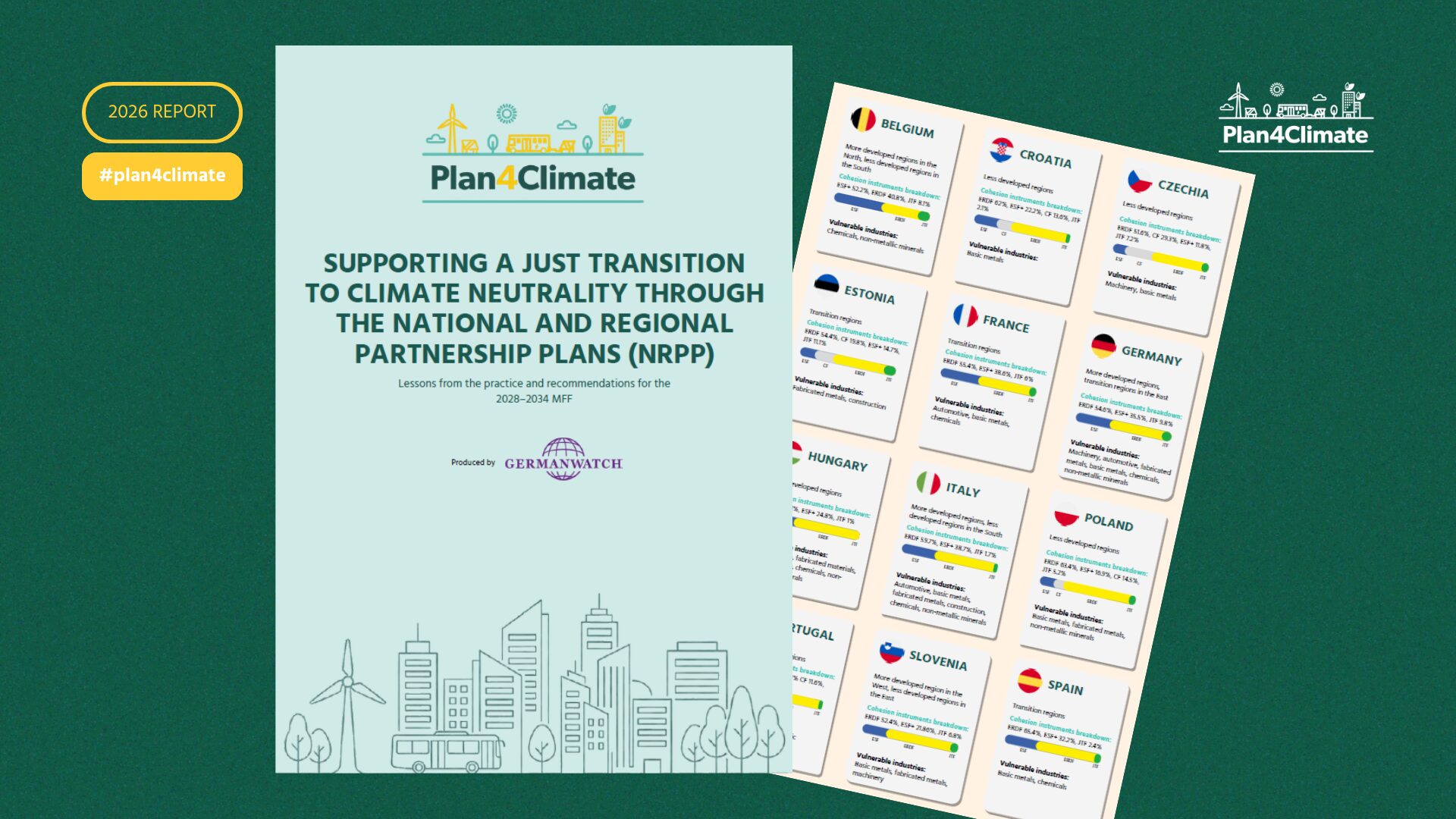
How to Make the NRPPs Work for a Just Transition to Climate Neutrality
From 1 January 2028, the European Union will manage a new budget through the 2028–2034 Multiannual Financial Framework (MFF). The European Commission has proposed merging cohesion policy funds, agricultural, migration, and Social Climate Fund resources into a single National and Regional Partnership Plan (NRPP) for each member state. This new Fund will constitute the main source of funding for climate and just transition objectives.
While the NRPPs aim at streamlining EU funding, a critical question remains: can a centralised instrument pooling so many objectives effectively support a just transition to climate neutrality?
Why this work matters
Strong national climate policies can help reduce emissions while also delivering tangible benefits for society, such as greater energy security, more affordable and efficient energy systems and cleaner environment.
“At a time of increasing climate impacts, rising energy costs and economic uncertainty, accelerating decarbonisation efforts is more important than ever and has to happen in each country.”
Brigitta Bozso