LIFE REALS
Renewable Energy in Artificial Land Surfaces
About the Project
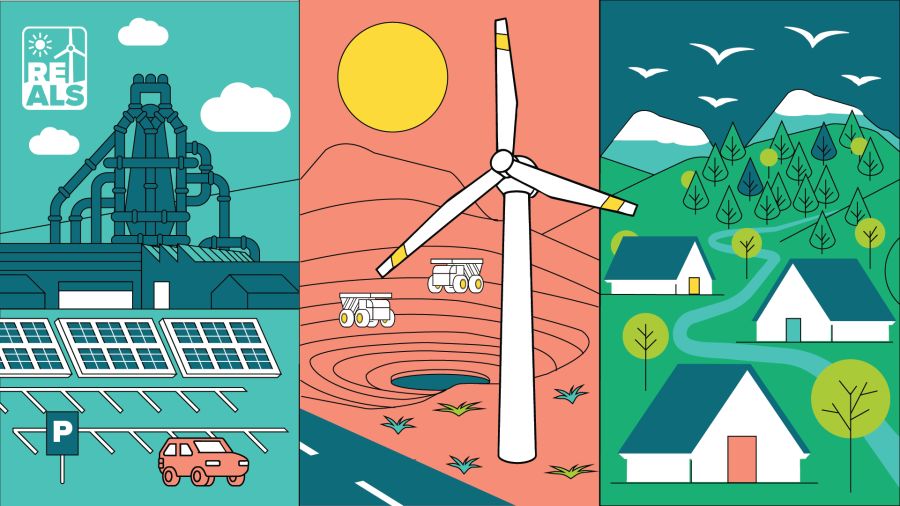
The project aims to address existing barriers, to make it easier and faster to develop wind and solar energy projects, especially on artificial land surfaces (ALS), while protecting nature and supporting local communities.
The Renewable Energy Directive requires Member States not only to speed-up and streamline renewable energy permitting process, but also to prioritise artificial and built surfaces. While the current permitting streamlining focuses more on selected process-related permitting elements which are most responsible for the permitting delays, barriers related to site-selection or spatial planning receives less attention. These barriers are especially relevant for artificial lands, which are often deprioritised over green field investments.
In order to address these problems, the overall objective of LIFE REALS is: “By 2028, permit-granting authorities and related governmental bodies in 5 target countries (Bulgaria, Hungary, Romania, Spain, Ukraine) have sufficient knowledge and capacity to overcome administrative permitting barriers, market constraints and ensure social inclusion related to onshore W&S deployment on artificial land sites, with results extended to EU-Level through at least 7 EU MS.”
This will be achieved through the following main specific objectives:
- Credible, integrated knowledge base will provide spatial data and policy analysis of permitting, market and social-related barriers, best practices and recommendations on wind and solar deployment in artificial land surfaces.
- Public authorities in the target countries and at least in 7 other Member States will have increased knowledge and capacity through participating in national and EU-level expert groups, training series and through an online knowledge hub.
- Decision makers in the target countries and beyond will be demonstrably influenced through targeted advocacy towards streamlining permitting and prioritising artificial lands in renewable investments.
- Increased awareness of 1 million citizen of low-conflict energy transition.
Views and opinions expressed are however those of the author(s) only and do not necessarily reflect those of the European Union or CINEA. Neither the European Union nor the granting authority can be held responsible for them.