Build Better Lives
Decent, affordable and energy efficient homes for all
Build Better Lives is a pan-European campaign that brings together social, climate and youth organisations to promote the need for more energy-efficient buildings that improve people’s lives across Europe. The campaign unites more than 100 civil society organisations around a shared vision of a socially just built environment that lifts millions of people out of energy poverty.
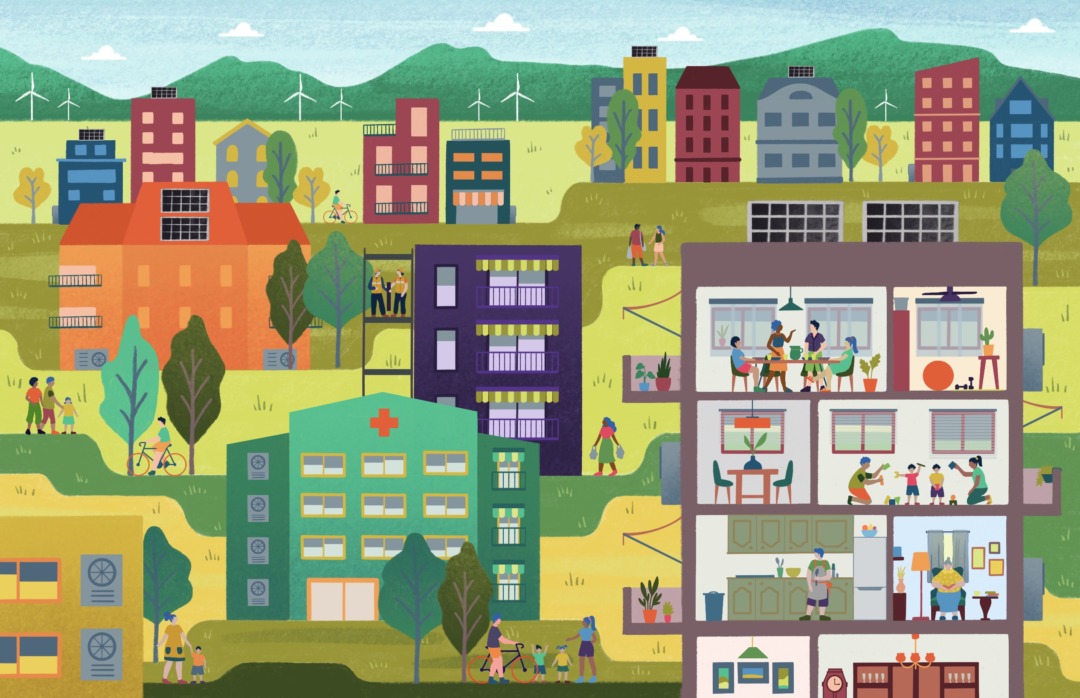
Better buildings build better lives by creating safer, healthier and more comfortable places to live, work and learn. Improving the energy performance of buildings reduces energy consumption, lowers household energy bills and cuts greenhouse gas emissions.
Building better lives through ambitious renovation policies
A key part of this work is advocating for ambitious National Building Renovation Plans (NBRPs) under the revised EU Energy Performance of Buildings Directive. These plans are a unique opportunity for Member States to deliver people-centred renovation strategies that prioritise those living in the worst-performing buildings and those most affected by energy poverty.
The first draft NBRPs were due by 31 December 2025. Yet many Member States failed to meet this legal deadline, delaying action that millions of people across Europe cannot afford to wait for.
What You Need to Know
-
Across Europe, millions of people live in cold, damp, overheated in summer, and unaffordable homes. At the same time, our buildings are at the heart of the climate crisis and the cost-of-living crisis. How we renovate our homes matters for our health, our energy bills, our communities and our future.
National Building Renovation Plans will shape the future of our homes, our energy bills and our communities. If they are weak, poorly designed or written behind closed doors, people will pay the price, especially vulnerable households already struggling with high energy costs and poor housing conditions. But if these plans are ambitious, inclusive and people-centred, they can deliver warmer, healthier and more affordable homes for everyone.
This opportunity must not be missed. Now is the moment to increase pressure on governments to open up the process, ensure meaningful public participation, and place social and climate justice at the heart of their plans. Priority must be given to the worst-performing homes and to the households that need support the most. Take action today and make your voice heard.
National Building Renovation Plans (NBRPs) are legally required roadmaps that every EU country must prepare under the Energy Performance of Buildings Directive. Their purpose is simple: to explain how the country will renovate its buildings so that, by 2050, homes and other buildings become zero-emission, energy-efficient and affordable to run. Each government must submit a first draft by 31 December 2025 and a final version by 31 December 2026.These plans are not optional strategies. Under EU law, governments must clearly describe how they will reduce energy use and greenhouse gas emissions from buildings, including by renovating the worst-performing homes first. They must set national targets for 2030, 2040 and 2050, define how average energy consumption in residential buildings will decrease, and explain how fossil fuel heating systems will be progressively replaced. The plans must also detail what measures will be introduced, how much investment is needed, and where the money will come from.
Importantly, countries are also required to include strong social elements. They must identify households affected by energy poverty, outline targeted support for vulnerable and low-income households, and explain how renovations will remain affordable and accessible. They must describe financial support schemes, advisory services such as one-stop-shops, and safeguards to ensure people are not unfairly burdened. In short, NBRPs decide how homes will be improved, how bills can go down, and how public money will protect those who need it most for the next decade and beyond.
Toxic pesticides banned in Europe could end up on our plates again if this deal goes ahead.
The EU-Mercosur trade deal would allow massive amounts of meat, soy and grains, fruit and vegetables from South America—where pesticides banned in Europe are still widely used—to more easily access our markets. This isn’t just a trade deal—it’s a backdoor for toxic chemicals to sneak onto our plates.
It’s a gift to Big Agribusiness, but a disaster for our health and Europe’s small-scale, local farmers. While family farmers are forced to follow strict environmental and health standards, corporate giants would be free to import cheap food containing banned pesticides. It’s unfair, unsafe, and therefore completely unacceptable.
Buildings are one of the biggest sources of energy use and emissions in Europe. Many homes are poorly insulated, expensive to heat, and uncomfortable during heatwaves. Buildings are also our homes, where we spend an important part of our lives.
These plans should decide how and when homes will be renovated, how heating systems will change, and whether energy bills will actually go down. NBRPs must include a clear roadmap to reach a zero-emission building stock by 2050, with milestones for 2030 and 2040 (Article 3 and Annex II EPBD). They must prioritise the renovation of the worst-performing buildings, reduce dependence on fossil fuel heating, improve insulation, and make homes more climate-resilient. But beyond technical targets, the Directive also requires that plans address energy poverty, vulnerable households, and housing affordability, including identifying affected groups, setting out targeted support measures, and estimating expected social benefits (Annex II EPBD). This means the plan determines whether families remain trapped in cold, damp, unhealthy homes ; or move toward safe, comfortable and affordable housing.
Crucially, NBRPs must also contain social safeguards. This includes measures to protect vulnerable consumers, ensure fair access to renovation funding, and prevent negative side effects such as exclusion from support schemes or disproportionate cost burdens (Annex II EPBD). Plans should explain how low-income households will receive adequate financial support, how tenants will be protected when renovations take place, and how access to information and advisory services, such as one-stop-shops, will be guaranteed. Governments must also outline financing sources and administrative capacity, ensuring that public money is targeted where it is most needed. In short, these plans shape not only climate action, but also social justice, housing rights, and protection against energy poverty for the next decade; which is why citizens have every reason to demand that they are ambitious, fair, protective and delivered on time.
Yes. Public participation is a legal obligation, not a political choice.Under the revised EPBD, Member States must ensure meaningful public participation in the preparation of their National Building Renovation Plans.
This obligation is explicitly laid down in Article 3(4) EPBD, which requires Member States to consult stakeholders, in particular local and regional authorities, social partners, civil society organisations, and bodies working with vulnerable households, when drafting their NBRPs. The draft plan must also include a summary of the consultation results
This means consultations should be transparent, inclusive and organised early enough for people’s input to actually matter.
Consultations that happen too late, too quickly, or without real access to information do not meet the spirit of EU participatory governance.
People must have a real say in how their homes and communities are transformed.
Brazil’s largest umbrella Indigenous organisation, the Articulation of Indigenous Peoples of Brazil (APIB), has publicly opposed this deal on the grounds that it would threaten their lands. Research has found that Indigenous territories will face increased deforestation pressure because of this deal.
Moreover, the deal fails to provide adequate protection for the rights of Indigenous Peoples and Local Communities against the adverse impacts of agribusiness expansion and land grabbing.
Instead of enhancing the protection for Indigenous People and local communities, the provisions of the deal weaken the wording “free, prior and informed consent” (recognised by the UN as an essential guarantee of Indigenous People’s rights over the land they live on) to “prior informed consent”. That they don’t even use the established human rights norm in this provision is more evidence that the rights of Indigenous Peoples were not a high priority in the trade deal.
An NBRP should not be treated as a box-ticking exercise. It is a once-in-a-decade opportunity to reshape housing systems.
An ambitious and fair plan should ensure real participation, meaning ongoing dialogue with communities and stakeholders rather than a one-off consultation.
It should prioritise deep and holistic renovations, not superficial upgrades. This means combining insulation, ventilation, renewable energy and clean heating systems to deliver lasting benefits.
It must include a clear pathway to phase out fossil fuels in heating and cooling, replacing them with renewable and efficient solutions while protecting households from sudden costs.
It should put social and climate justice at the centre, ensuring that energy-poor households, tenants, and vulnerable communities benefit first, not last.
It must provide adequate and accessible financing, especially grants and support for low-income households. Funding schemes should be simple, understandable, and supported by advisory services such as one-stop-shops.
Finally, it should empower local authorities, because renovation happens on the ground. Municipalities need resources, staff, and tools to implement these plans effectively.
If governments delay their plans, limit public participation, or avoid ambitious measures, the consequences could be serious.
Families may continue to face high energy bills and unhealthy housing conditions. Vulnerable households could be left behind. Climate targets could be missed. Public trust in the transition could erode.
A weak plan today means higher costs social, economic and environmental — tomorrow.
The European Commission is responsible for overseeing the implementation of EU law.
It reviews national plans, assesses whether they meet legal requirements, and can request improvements if necessary. If a Member State fails to comply with its obligations, the Commission has enforcement powers under EU law.
Strong oversight is essential to ensure governments do not submit delayed or insufficient plans.
Renovation policies affect everyone: tenants, homeowners, social housing residents, rural communities, older people, and families struggling with energy bills.
When citizens speak up, governments are more likely to act transparently and responsibly. Public pressure can help ensure that plans are ambitious, inclusive, and people-centred.
The transition of Europe’s buildings must not happen behind closed doors.
The email action was available in all EU Member States. In France, Italy, Spain, Poland and Bulgaria, the action was translated into the local language, allowing participants to send emails directly to their national authorities. In all other countries, participants sent their messages to the European Commission, urging it to pressure Member States to comply with their legal obligations under the revised Energy Performance of Buildings Directive.