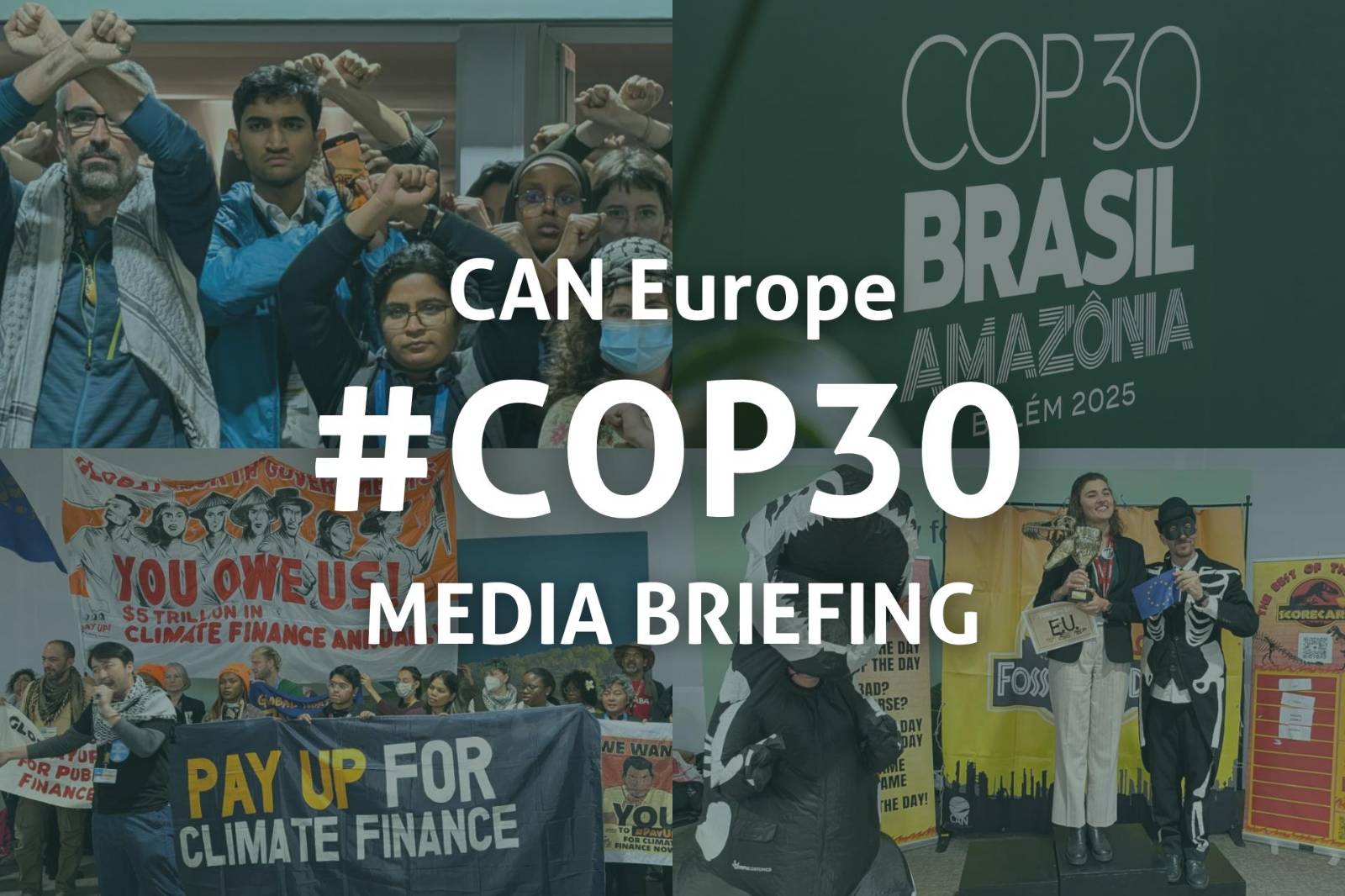
CAN Europe’s Key Demands for COP30
Just Transition At COP30, Parties must establish an International Mechanism for Just Transition to drive a fair, holistic shift across all sectors and countries. This mechanism should operationalise agreed UNFCCC principles, enabling transitions away from fossil fuels, transforming food and industrial systems, and guaranteeing affordable access to clean energy and sustainable livelihoods. The EU should be vocal in supporting efforts to agree on the principles, safeguards, and an international action plan ensuring transitions are rights-based, inclusive, grounded in equity, and anchored in the UNFCCC and Paris Agreement – backed by public finance, technology transfer, and fair global cooperation. “COP30 must deliver a Just Transition that works for people and the planet,” said James Trinder, International Climate Policy Coordinator at CAN Europe. “The EU should champion the call for a new international mechanism that turns promises into coordinated action – ditching incrementalism and a few technologist’s vision of speculative fixes – and instead supporting countries to transform their societies away from fossil fuels, protect workers and nature, and unlock affordable clean energy for all. A real Just Transition means decent jobs, social protection, and fair access to finance and technology, so that no one is left behind in the shift to a 1.5°C world.” Climate finance To deliver a fair and ambitious outcome in Belém, the EU must put public finance at the heart of the negotiations. While recent Finance Minister discussions concluded with the need for new resources, the continued overreliance on private finance for countries in the Global South risks repeating past failures. Private capital has simply not delivered at the scale or speed required. The EU must now advocate at COP30 for scaling up new and additional public climate finance to meet its fair share of the USD 300 billion target under the New Collective Quantified Goal (NCQG) by 2035. Adaptation and loss-and-damage finance must increase sharply and be delivered mainly as grants, not loans. Equitable fossil fuel, aviation, and wealth taxes could provide the new revenue streams at the scale needed. The EU must also ensure ambition in phasing out fossil fuel finance and shifting finance flows globally in line with climate resilient development, by committing to lead with other wealthy countries domestically and looking at debt, tax, and trade systems to free fiscal space for investment and break the cycle of dependence on climate-harming industries in Global South countries. “In Belém, the EU needs to step up its game by backing a goal to at least triple adaptation finance, committing along with other wealthy countries to phase out fossil fuel finance, and supporting international reforms that make finance fair, predictable and aligned with climate justice”, said Rachel Simon, Senior Policy Coordinator at CAN Europe. – Read CAN Europe’s detailed demands for COP30: www.caneurope.org/cop30 – which include recommendations on safeguarding civic spaces, championing gender, transforming the global energy system as well as specific demands for the Western Balkans. –CAN Europe COP30 Delegation
From the CAN Europe Network, there will be 70+ delegates from 20+ European countries present in Belém for COP30. The CAN Europe secretariat delegation in Baku consists of:- Chiara Martinelli – Director
- Sven Harmeling – Head of Climate
- James Trinder – International Climate Policy Coordinator
- Frosina Antonovska – Climate and Energy Policy and Network Coordinator for the Western Balkans
- Tomas Spragg Nilsson – Senior Communications Coordinator
- Jani Savolainen – Communications Coordinator
- Samuel Martin-Sosa – Head of Network
- Pablo Chamorro – Campaigns and Mobilisation Network Coordinator
Side events
Outside of the formal negotiations, CAN Europe and its member organisations have organised and will participate in a number of side events during COP30. The full details of these 50+ side events taking place during COP30 can be found hereMobilisation
Grassroots movements, civil society organisations and climate activists are organising actions in Belem, both inside and outside the official UN zone, putting pressure on the negotiations. “This is the first COP in four years where actions outside the official venue are welcomed. After multiple years in a row where the civil society and activists were silenced and sidelined, we will take full advantage of using the opportunities to call for an ambitious outcome in Belem”, said Samuel Martin-Sosa, Head of Network at CAN Europe. “COP30 needs to be the space to embrace diverse voices, including the Indigenous Peoples native to the region.” The Global Day of Action on 15 November mobilises environmental, climate and social movements, both in Belem and around the world, coinciding with the mid-point of COP30. As part of the People’s Summit, thousands are expected to take to the streets of Belém, demanding climate justice and system change. In Europe, actions on 15 November are planned in Spain, Italy, Denmark, Portugal, Switzerland and more. ENDS Notes to the Editor:- CAN Europe’s detailed demands for COP30
- Join the CAN Europe COP30 mailing list for journalists
- Follow our COP30 WhatsApp broadcast group to receive short term tips, reactions and invitations to press huddles on the ground.