26th June 2026, Brussels – As the EU Energy Council concludes in Luxembourg this evening, against the backdrop of scorching heatwaves and a worsening climate crisis, the messages coming from Member States are conflicting. On one hand, there is the push to electrify Europe, ensuring a coordinated approach towards developing Europe’s grid network and electricity infrastructure in order to boost energy security. Yet, on the other hand, there are calls from a handful of Member States to weaken, reopen, or postpone the EU methane regulation based on incorrect statements about cost and energy security impacts that rely on false assumptions.
On a positive note, the Council reached a General Approach on the European Grids Package, agreeing to commit to a central scenario led by the Commission to direct the planning of cross-border energy infrastructure. EU Countries secured measures to allow for more national input, though failed to increase transparency via introducing the use of an open-source model. This new process can support more efficient and streamlined planning, helping to remove grid bottlenecks and allow freeflowing renewable power.
The Cyprus Presidency has fortunately found a compromise on the use of congestion revenues, keeping the proposal to use revenues to support EU cross-border projects, while recognising the different national context with countries with multiple bidding zones. Under the Permitting Directive, Member States have agreed to include new benefit-sharing provision, meaning renewable projects will directly support local communities. The upcoming Irish Presidency will lead negotiations on trilogues, once the Parliament reaches its own position.
Today’s deal on the Grid Package is a positive show of European solidarity as we try to reduce our reliance on costly fossil fuels. An agreement on a common, central scenario will allow for the more efficient and streamlined planning of our European network, unleashing the cross-border flow of affordable renewable power. Unfortunately, the use of an open-source model was not introduced, limiting transparency. The Cyprus Presidency has managed to find a balance on the use of congestion revenues. New benefit-sharing provisions means renewable projects will now directly support the local communities. It will now be up to the Irish Presidency to ensure this file remains focused on prioritising electricity, and that no back doors are opened to the funding of fossil infrastructure or generation. – Tom Lewis, Energy Policy Coordinator at Climate Action Network (CAN) Europe
Also on the agenda for the first time was the post-2030 EU energy framework for the first time discussed by Ministers. Rising oil and gas prices are overshadowing the success of the current 2030 energy and climate framework, which has already helped shield millions of households and businesses from higher energy costs with the accelerated deployment of renewable energy and energy efficiency measures. While some Member States advocate for technology neutrality, this could risk leading Europe’s energy transition down a path to more costly and slower solutions such as nuclear. Rather, the post-2030 framework should build on the successes of the current framework and close the remaining gaps to fully accelerate energy transition.
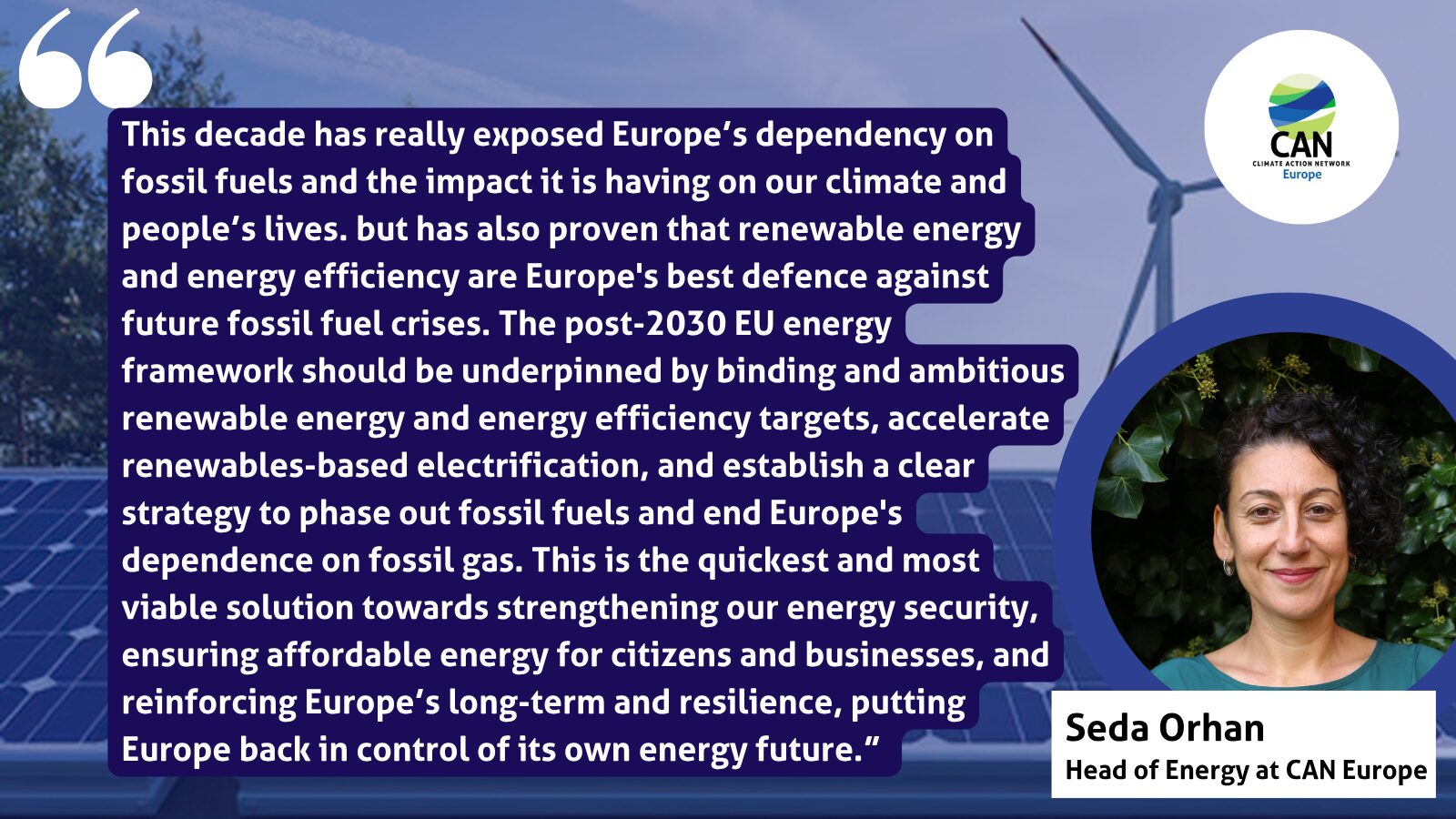
This decade has really exposed Europe’s dependency on fossil fuels and the impact it is having on our climate and people’s lives. but has also proven that renewable energy and energy efficiency are Europe’s best defence against future fossil fuel crises. The post-2030 EU energy framework should be underpinned by binding and ambitious renewable energy and energy efficiency targets, accelerate renewables-based electrification, and establish a clear strategy to phase out fossil fuels and end Europe’s dependence on fossil gas. This is the quickest and most viable solution towards strengthening our energy security, ensuring affordable energy for citizens and businesses, and reinforcing Europe’s long-term and resilience, putting Europe back in control of its own energy future.” – Seda Orhan, Head of Energy at Climate Action Network (CAN) Europe
What is still missing is a EU fossil fuel exit strategy which needs to be a structural pillar of this post-2030 framework. This needs to be underpinned with the delivery of a timely and ambitious implementation of the EU Methane Regulation, rejecting any reopening or early review of methane rules. Those Member States that recognise the far-reaching benefits of reducing methane waste should stand up and champion this Regulation, defending it as a key pillar of EU energy security and a crucial step toward breaking free from fossil fuel dependence.
“Calls from 12 Member States to suspend the EU methane regulation worryingly echo the fossil fuel industry and the US administration’s campaign to roll back methane rules at a time when implementation is key. In reality, the regulation does not ban gas imports. Instead, it provides phased compliance pathways, and compliant global gas supply already exceeds the EU’s import needs by more than three times. Claims of security of supply risks are at odds with market reality. The UN Secretary-General’s recent Call to Action on Methane is a timely reminder of what’s at stake. The EU should not give in to pressure and fully implement methane rules, while acting to phase out its dependence on fossil fuels altogether.” – Esther Bollendorff, Fossil Free Manager at Climate Action Network (CAN) Europe
ENDS
Notes to Editor:
CAN Europe Letter to Ministers ahead of the 26 June Energy Council
Letter from Civil Society and Industry on binding post-2030 EU energy targets
Joint letter from 28 civil society organisations to President von der Leyen and Member States on protecting the EU Methane Regulation