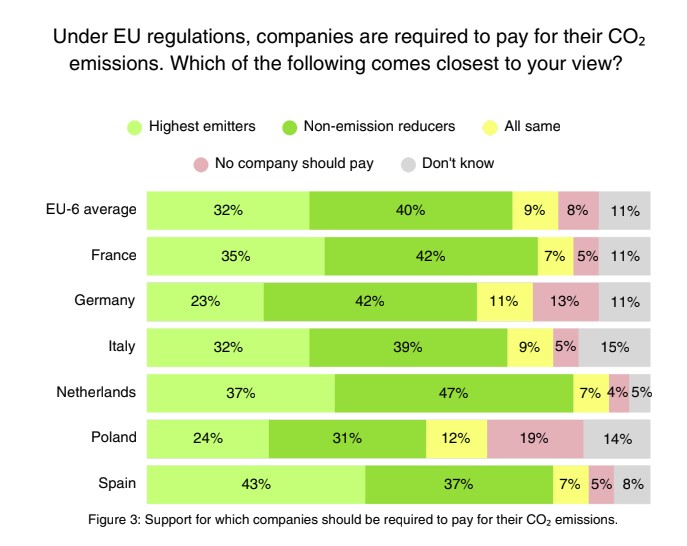
Brussels/Berlin, 1 July 2026 – Seven out of ten European citizens (72%), including those voting for parties often portrayed as sceptical of EU climate policy, believe that companies that emit the most – or fail to reduce their emissions – should pay more. A new poll, commissioned by Beyond Fossil Fuels on behalf of a broad community of organisations, and conducted by YouGov across six European countries, finds broad support for the “polluter pays” principle at the heart of the EU Emission Trading Scheme (ETS), cutting across national and political divides.
As the European Commission prepares to reveal its proposal for the EU ETS on 15 July, the poll’s findings challenge calls from industry and political leaders to weaken the mechanism, revealing widespread public support for its core principles: making polluters pay, rewarding industrial decarbonisation. Citizens also support that if companies continue benefiting from free allowances, they must come with conditions attached.
Carlota Ruiz Bautista, Steel and Industry Campaigner at Beyond Fossil Fuels, said:
“The war in the Middle East is once again showing Europe the cost of fossil fuel dependence, in geopolitical risk, energy insecurity, and economic fragility. European citizens get it: you can’t have a resilient industry without a clean one. Political leaders must now listen to their citizens and stop letting big polluting companies like ArcelorMittal, Thyssenkrupp, Voestalpine and BASF hollow out the EU ETS, the very mechanism designed to drive that green industrial transformation.”
A majority of 59% of respondents across France (66%), Germany (47%), Italy (65%), the Netherlands (71%), Poland (40%) and Spain (68%) think that heavy industries, such as steel, cement, and chemicals, should pay for their CO₂ emissions. Support rises to more than two-thirds in Spain, France, Italy and the Netherlands, while opposition across the six countries stands at just 23%. Beyond pricing polluters, respondents also expect the system to reward climate ambition, with 7 out of 10 participants believing that companies emitting the most – or failing to reduce their emissions – should pay more than others.
Support goes well beyond the “green electorate”, including even voters of governing parties that have called for changes to or a weakening of the EU ETS. This becomes strikingly clear in Italy, where 71% of voters of Fratelli d’Italia, the party led by Prime Minister Giorgia Meloni, express support for making heavy industries pay for their emissions. In France, 73% of Emmanuel Macron’s voters and 55% of Marine Le Pen’s voters back the same principle. In Poland, 57% of voters of Koalicja Obywatelska (KO), led by Prime Minister Donald Tusk, are in support.
The latest attack on the Emissions Trading System by steel giants ArcelorMittal, ThyssenKrupp and Voestalpine and chemicals giant BASF marks one of industry’s most direct calls yet for the EU to retreat on climate action. However, citizens want to stay the course. One in two respondents (50%) favour governments collecting carbon revenues and investing them directly in industrial decarbonisation, compared with just 18% who believe energy-intensive industries should not have to pay for their carbon emissions at all. Where companies continue to benefit from free allowances, 62% believe these should only happen on the condition of investing in reducing future emissions. Meanwhile, 63% believe this should only happen if energy-intensive industries support a just transition for workers by investing in workforce reskilling, staff training and high-quality working conditions.
The poll’s results show that citizens are ahead of the political debate. They back making heavy industry pay for its emissions, favour investing carbon revenues in industrial transformation, and expect any support in the form of free allowances to come with conditionalities that cut emissions and deliver benefits for workers and communities.
Boris Jankowiak, Steel Transformation Policy coordinator at Climate Action Network Europe, said:
“The idea that weakening the EU ETS is the best way to protect European industry is being challenged by reality. Europe is already losing industrial capacity and jobs in many sectors despite decades of free allowances and billions of euros in public support. Continuing to grant free allowances without strings attached will not produce different outcomes and gives no guarantee that production or jobs will remain in Europe. Instead, it will reduce the size of the envelope available to support industrial transition and punish first movers.”
ENDS
Briefing: What European citizens expect from the EU Emissions Trading System
A majority of 59% of European citizens support measures requiring energy-intensive industry to pay for its CO₂ emissions; only 23% are against. An overwhelming 72% believe that companies emitting the most—or those failing to reduce their emissions—should pay more than others. Only 9% favour all companies paying the same amount, while just 8% believe companies should not be required to pay at all.
FOR MORE INFORMATION and media requests:
- Jani Savolainen, Communications Coordinator, CAN Europe | jani.savolainen@caneurope.org | +358 504667831
- Lidia Tamellini, Expert on EU Industrial Decarbonisation, Carbon Market Watch | lidia.tamellini@carbonmarketwatch.org | +32 472836206
- Florian Cassier, Climate Communications Officer at WWF EU | fcassier@wwf.eu, | +32 479 33 92 11
- Carlota Ruiz Bautista, Steel and Industry Campaigner, Beyond Fossil Fuels | carlota.ruiz@bff.earth | +34 669111640
- Eve Nieminen, Senior Communications Officer, E3G | eve.nieminen@e3g.org | +32 491268869
- Wojciech Szymalski, Director, Institute for Sustainable Development Foundation, Poland | w.szymalski@ine-isd.org.pl | +48 507 126 893
- Aurélie Brunstein, Responsable industrie lourde, Réseau Action Climat France | aurelie.brunstein@reseauactionclimat.org | +33 7 88 74 00 09
KEY FINDINGS
- A majority of 59% of European citizens support measures requiring energy-intensive industry to pay for its CO₂ emissions; only 23% are against. Support extends across political divides, reaching well beyond the traditional green electorate.
- An overwhelming 72% believe that companies emitting the most—or those failing to reduce their emissions—should pay more than others. Only 9% favour all companies paying the same amount, while just 8% believe companies should not be required to pay at all.
- One in two (50%) favour investing carbon revenues in industrial decarbonisation, rather than extending free allowances; only 18% support continued free allocation.
- A majority of 62% believes that, where companies are exempted from paying for their CO₂ emissions, they should be required to reinvest the value of those exemptions in reducing future emissions.
- Similarly, 63% of European citizens believe that companies benefiting from exemptions from carbon pricing should support a just industrial transition by investing in workforce reskilling, providing staff training and guaranteeing high-quality working conditions.
- One in two (50%) believes that companies benefiting from exemptions should involve local communities in decisions about industrial transformation and its impacts.
NOTES
- Any figures referring to ‘Europe’ figures are an average of the results across the six countries included in the survey conducted by YouGov (France, Germany, Italy, the Netherlands, Poland and Spain).
- Methodology – The European Political Monthly (EPM) survey was conducted by YouGov on behalf of a broad community of experts and civil society organisations who are advocating for a green industrial transition in Europe: Beyond Fossil Fuels, CAN Europe, Carbon Market Watch, Ecodes, EEB, E3G, Germanwatch, Natuur&Milieu, WWF European Policy Office, and WWF Italy. All figures, unless otherwise stated, are from YouGov Plc. The total sample size was 6,156 adults (with nationally representative samples of 1,099 in France, 1,095 in Germany, 1,035 in Spain, 1,003 in Italy, 1,007 in the Netherlands and 1,007 in Poland). Fieldwork was undertaken between 6-18 May 2026. The survey was carried out online. The figures have been weighted and are representative of all adults aged 18+ in each of the six respondent countries.
Additional quotes from partners
EU
Lidia Tamellini, Expert on EU Industrial Decarbonisation at Carbon Market Watch, said: “Almost 60% of Europeans want heavy industry to pay for its CO2 emissions and policymakers must now demand full application of the “polluter pays” principle, in line with what European citizens are asking for. The climate crisis affects everyone, but has clear culprits: making them pay is simply common sense.”
Camille Maury, Senior Policy Officer for Industrial Decarbonisation at WWF EU, said: “EU policymakers should not only listen to industry lobbyists but also to European citizens. Across the political spectrum, Europeans send a clear message: maintain a strong carbon price rooted in the polluter pays principle, and phase out free allowances. Where allowances remain, they must be tied to real industry commitments to decarbonise. Weakening the ETS would disregard public opinion and undermine the investment certainty needed for Europe’s industrial transformation. Europeans support a system that rewards early movers driving decarbonisation, not laggards resisting change.”
France
Aurélie Brunstein, Heavy industry policy advisor at Réseau Action Climat said: “As the European Commission prepares to unveil its proposal to revise the European carbon market mid-July, this survey results contradict calls from industry representatives and some Member States to weaken this pillar of the EU climate policy. There is indeed a broad public support for its fundamental principles: making polluters pay, rewarding industrial decarbonisation and reinvesting carbon revenues in just transition solutions. We call on the French Government and MEPs to defend a strong carbon market during its revision in the coming months.”
Germany
Dr. Simon Wolf, Head of German and European Climate Policy at Germanwatch, said: “European citizens across party lines are sending a clear message that support for energy-intensive industries must come with clear conditionalities. In Germany, a majority of 60 percent of voters think that to benefit from carbon pricing exemptions, companies must reinvest those benefits into emissions reductions and a just transition for workers. Investment leakage is the real competitiveness threat for Europe and handing out public money without clear conditionalities only accelerates it.”
Italy
Mariagrazia Midulla, Head of Climate and Energy at WWF Italy said: “European governments who have hopped on the bandwagon of trying to water down the ETS are essentially acting without a voter mandate. For example, in Italy, over two thirds of voters of the party leading the current government responded that they want heavy industry to pay for their emissions. Staying loyal to their electorate means supporting a strong ETS.”
Netherlands
Michèlle Prins, Program Lead Industrial Transformation at Natuur & Milieu said: “Carbon pricing is a cornerstone of climate policy for industry. It has been driving significant emissions reductions by ensuring that polluters pay. This survey shows that a majority of both Dutch and European citizens support requiring heavy industry to pay for its CO₂ emissions. The Netherlands stands out not only for its strong support for carbon pricing, but also for its clear understanding of the role carbon pricing plays in driving investment and industrial transformation. It clearly shows that staying the course with carbon pricing has the support of the people.”
Poland
Wojciech Szymalski, Director at the Institute for Sustainable Development Foundation, said: “More people support than oppose making the industry pay for their emissions in Poland, yet it is no wonder that Polish society shows less support for carbon pricing than other countries. Polish politicians have invested a lot in the last few years to avoid the implementation of ETS2 and question the necessity of ETS in front of public opinion, partly because of the anti-climate policy disinformation threats from Russia. All that because there is a strong group of coal miners who have been mobilised to oppose attempts at earlier closure of coal mines, despite most of them running at a deficit. Moreover, the biggest Polish state-owned companies live on imported fossil fuels. Staying on coal, oil and gas is like digging our own Polish grave, because the energy dependency on imports runs up almost every year. Nevertheless, Polish politicians fight between right and left rather than fighting real problems with the Social Climate Plan, and the polluter pays principle.”
Spain
Juan Fer Martín, Senior Industrial Decarbonisation Policy Officer at ECODES, said: “Spaniards are among the strongest supporters of making polluters pay in Europe (68% want it) and that is no accident. Europe’s competitiveness will not be built by lowering climate ambition, but by reducing the structural vulnerabilities that fossil dependence imposes on our industry. A strong, predictable carbon price is precisely what gives sectors like steel and cement the certainty to invest in clean production at home. Weakening the ETS now would punish the companies already moving first and reward those refusing to change.”
Briefing: What European citizens expect from the EU Emissions Trading System
A majority of 59% of European citizens support measures requiring energy-intensive industry to pay for its CO₂ emissions; only 23% are against. An overwhelming 72% believe that companies emitting the most—or those failing to reduce their emissions—should pay more than others. Only 9% favour all companies paying the same amount, while just 8% believe companies should not be required to pay at all.