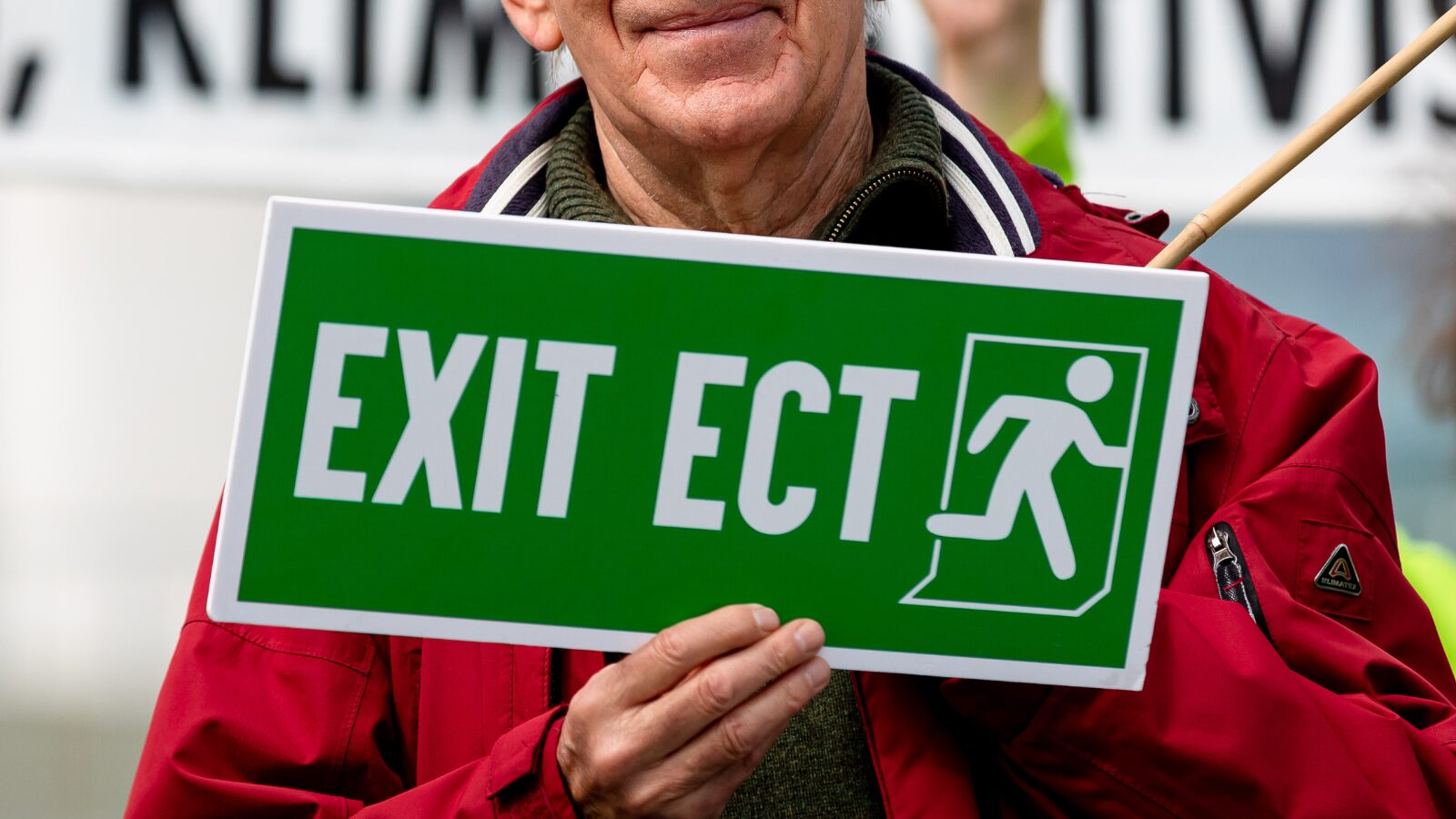
Brussels/Bucharest/Dublin/Stockholm, 6 May 2026 – A new wave of European countries is abandoning the climate-wrecking Energy Charter Treaty (ECT), hinting at a further degradation of the controversial pact that allows fossil fuel investors to sue governments over climate and energy policies.
In 2026, Iceland, Moldova, Romania, Sweden, Bulgaria and Ireland have either exited the Treaty or launched the process to do so. They join a large group of other European countries already exited, and the EU itself, which withdrew in 2024.
The ECT has become notorious for allowing energy companies to use secretive investor-state tribunals to claim millions or even billions from taxpayers when governments adopt public-interest measures affecting their profits, including climate and energy laws. The recent cases include a fossil fuel investor Klesch Group suing the EU, Germany and Denmark over the 2022 fossil fuel windfall tax, enacted as a response to Europe’s previous energy price crisis.
Leah Sullivan, Trade and Climate Policy Coordinator at CAN Europe, said:
“The Energy Charter Treaty has become a fossil fuel industry’s weapon against climate action. Every new withdrawal is another sign that governments are no longer willing to let outdated investor privileges stand in the way of the energy transition. The ECT is politically toxic, economically unjustifiable and completely incompatible with the climate crisis.”
This latest exodus follows a January letter from the European Commission urging the remaining EU-linked signatories to withdraw without delay, signalling growing political recognition that the Treaty is incompatible with the EU’s climate goals. Romania explicitly cited climate concerns in its withdrawal decision, calling the Treaty’s fossil fuel protections “increasingly outdated” and incompatible with Paris Agreement commitments.
Raluca Petcu, from Bankwatch Romania, said:
“Romania’s ECT exit is one step closer to reducing the fossil fuel industry’s influence and aligning with EU policy on climate mitigation. However, major actions are still needed at the national level to ensure a fossil-free and just energy transition.“
Ireland’s exit was announced already in 2024, but it has taken two years for the Irish government to proceed with it and notify the ECT Secretariat.
Chris O’Connell, from Trócaire in Ireland, said:
“Energy Charter Treaty, and investor-state dispute settlement mechanism more broadly, has been proven time and again to be a huge obstacle to climate action. Equally positive with Ireland’s ECT exit is Ireland’s commitment to co-hosting the second international conference on transitioning away from fossil fuels in 2027 with Tuvalu. The second conference must play an important step in building the legally binding international mechanism to get the world off fossil fuels.”
However, despite the positive developments on ECT in Ireland, the Irish Government is simultaneously rushing through a new flawed legislation that will open the door to new investor-state dispute settlement (ISDS) claims, the Arbitration (Amendment) Bill.
Beyond ECT, ISDS provisions and extensive investor protections continue to be included in many other investment treaties, new and old.
Anja Ipp, from the Swedish Society for Nature Conservation, said:
“While leaving the ECT represents significant progress, Sweden is party to many other investment treaties that contain ISDS provisions and extensive investor protections. These are increasingly difficult to reconcile with the urgent need for action, not only to address the climate crisis, but also to safeguard biodiversity and protect ecosystems and human rights.”
Leaving the ECT does not fully eliminate the threat, not only because of the other investment treaties, including ISDS provisions, but also because of the ECT treaty’s so-called sunset clause. The sunset clause enables fossil fuel investors to continue bringing legal suits for up to 20 years after the treaty withdrawal.
Leah Sullivan added:
“Exiting the ECT is a major step forward, but governments must now go further. Unless countries work together to neutralise the Treaty’s sunset clause, fossil fuel investors will keep threatening climate action for decades. No government should remain trapped by a treaty designed to protect yesterday’s energy system.”
For more information and media requests:
Jani Savolainen, Senior Communications Coordinator, jani.savolainen@caneurope.org, +358 5046678331
Notes to the editors:
- The previous European countries which already exited the Energy Charter Treaty, in addition to the European Union itself, which left in 2024: Denmark, France, Germany, Italy, Lithuania, Luxembourg, the Netherlands, Poland, Portugal, Slovenia, Spain and the UK. Norway and Serbia never fully joined the Treaty. In 2026, Bulgaria, Iceland, Ireland, Moldova, Romania and Sweden have either exited the Treaty or launched the process to do so. The EU countries remaining in the treaty are: Austria, Belgium, Croatia, Cyprus, Czechia, Estonia, Finland, Greece, Hungary, Latvia, Malta, Slovakia.
- Some case examples:
- In 2024, Exxon Mobil launched an ISDS case under the ECT against the Dutch government as part of a set of arbitration cases demanding billions for its decision to phase out gas exploration in Groningen, the Netherlands.
- In 2022, the British oil company Rockhopper was awarded €190 million plus interest under the Energy Charter Treaty after Italy banned offshore drilling, following a decade of struggle by Italian coastal communities who denounced the danger of coastal drilling.
- Fossil fuel company Klesch Group Holdings Limited is suing the EU, Germany and Denmark for at least €175 million over windfall taxes under the Energy Charter Treaty. The lawsuit by the oil company emerged amidst Europe’s broader efforts to transition towards sustainable energy and overcome the economic impact of high energy prices.
- A new piece of research published in April revealed the extent of European countries involved in ISDS, finding high levels of concentration among a number of European countries, specifically the UK, Netherlands, Germany, France, Spain and Switzerland.
Read more on ECT:
-
Energy Charter Treaty modernisation adopted, still undermining climate action
3 December 2024 — The Energy Charter Conference finally adopted its proposal for modernising the climate-wrecking Energy Charter Treaty (ECT). Negotiations to… -
Historic victory: Council gives green light for EU withdrawal from climate-wrecking Energy Charter Treaty
Brussels, 30 May 2024 – The Council of the EU today adopted a historic decision to withdraw the European Union from the Energy Charter Treaty (ECT), an …