
The European Commission has unveiled its long-awaited review of the EU Emissions Trading System (EU ETS). This is a key opportunity to strengthen the system, particularly for Central and Eastern Europe, where it has already delivered significant emissions reductions and generated substantial revenues. If designed well, the revised EU ETS can do more than cut emissions – it can also strengthen economic security, support quality jobs, drive innovation, improve public health and deliver long-term prosperity.
Authors: Katarzyna Ugryn – CAN Europe, Sylwia Andrałojć-Bodych – Germanwatch, Heda Cepelova – Centre for Transport and Energy, Czechia, Alexa Botar – MTVSZ, Hungary.
The EU ETS has been at the centre of the European debate in recent weeks, following the European Commission’s proposal to revise the scheme ahead of trilogue negotiations due to begin in January. This revision is a key opportunity to strengthen one of Europe’s most important policy tools. But first, we need to move beyond the perception of the EU ETS as merely a carbon pricing mechanism. In reality, it has become one of Europe’s largest investment instruments. Since its creation, it has helped reduce emissions from covered sectors by 51% while generating hundreds of billions of euros in public revenues. In 2024 alone, the system raised €39 billion. Policy-makers should keep on ensuring that the revised ETS increases its capacity to mobilise and support the decarbonisation of the economy, particularly in CEE, even though the Commission proposal already weakens key elements of this policy tool, which risks delaying the speed and scale of the needed transition.
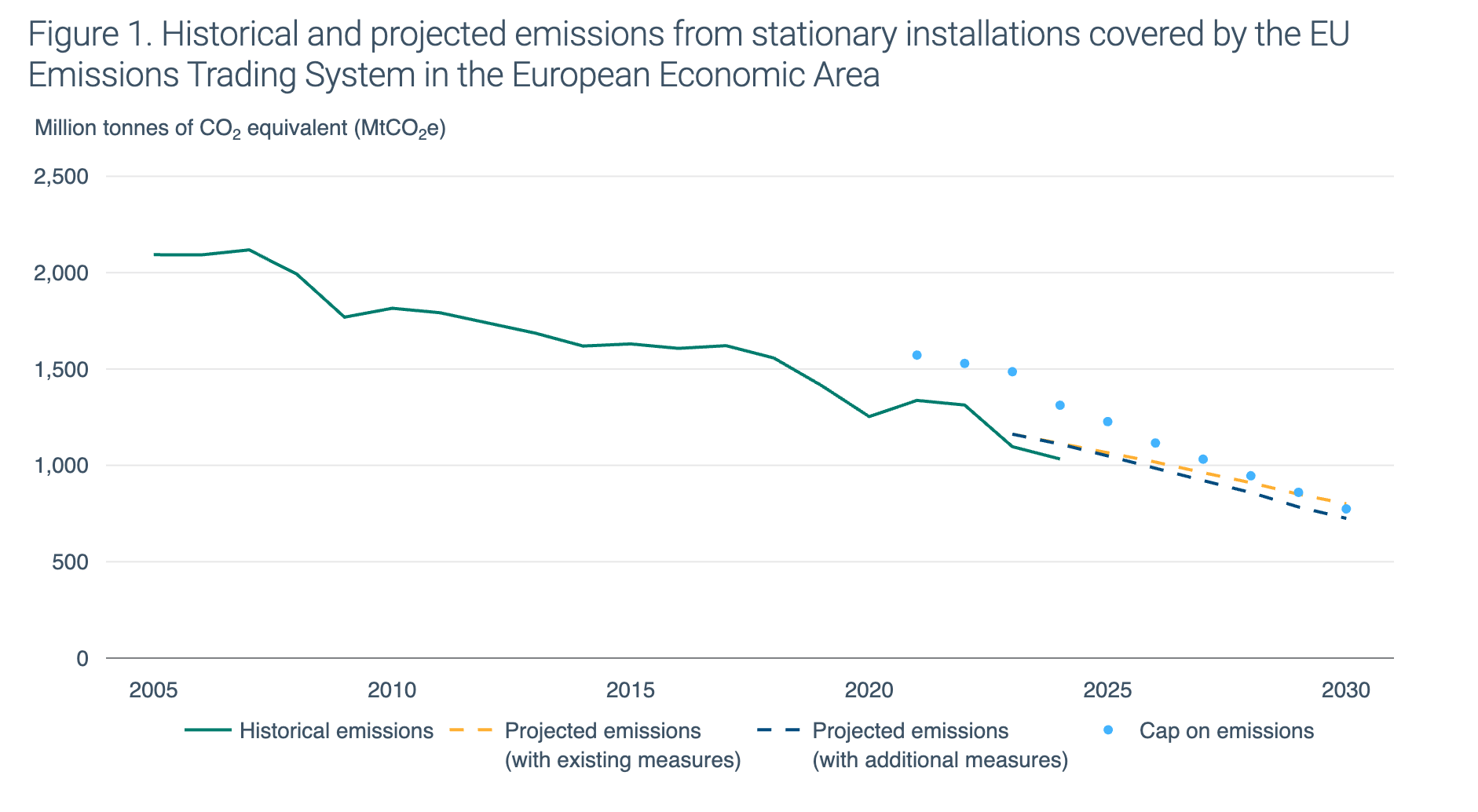
To achieve a well-functioning EU ETS, the trilogue outcome must address several key aspects:
- Accelerating further decarbonisation efforts
The ETS has already significantly contributed to the carbon emission reductions: In the EU ETS1 covered sectors by 51% since 2005, while the EU economy grew by nearly 30%. This progress is particularly visible in Central and Eastern Europe (CEE). At the same time, the system has generated substantial revenues — €39 billion in 2024 alone — which can be channelled into investments in clean technologies. Thus, the ETS has proven to be an effective instrument for sustainable development, incentivising shifts in consumption, production and investment decisions toward clean-tech and renewable-based solutions. However, most emissions reductions have occurred in the energy sector, with industrial decarbonisation progressing much more slowly (only a 17.1% decrease between 2005 and 2024). This highlights the urgent need to incentivise industrial transformation, ensuring that industry receives the support necessary to decarbonise at pace.
Recommendations:
- Ensure that a growing share of ETS revenues is effectively earmarked for transformative purposes such as industrial decarbonisation, while maintaining broader societal outcomes.
- Redirect fossil fuel subsidies towards continued support for the energy transition, thereby strengthening incentives for clean technologies and reducing structural dependence on carbon‑intensive sectors.
- Phase-out free allocations by 2034 to increase the share of available auctioned revenues and strengthen conditionality for remaining free allocations by linking them to binding and verifiable decarbonisation investments of equivalent value. To give companies greater flexibility, establish individual transformation accounts funded through auction revenues. This would provide industry with liquidity and temporal flexibility, prevent further windfall profits, and guarantee that unused funds are reinvested in pre‑defined decarbonisation projects.
- Embed ETS1 within a consistent and coordinated EU industrial policy toolbox such as CBAM, the Industrial Accelerator Act, and lead market initiatives. These instruments are mutually reinforcing industrial policy tools providing complementary protection and support for industrial transformation in Europe.
2. Enabling innovation and investment
The ETS must enable the complex development of the clean industries – such as production of heat pumps, batteries and development of other strategic technologies – while providing stability and predictability for long-term investments. A partial re‑channelling of ETS revenues to industry through support instruments is essential to facilitate market entry for new companies and innovations.
To support lower-income regions with a specifically carbon-intensive energy mix like some of the CEE countries and reflect different starting points of decarbonisation across the EU, two mechanisms were established, in the spirit of cohesion: the solidarity redistribution mechanism and the Modernisation Fund. The solidarity redistribution mechanism sets aside 10% of auctioned allowances for eligible Member States, allowing them to generate additional ETS revenues. Bulgaria is the largest beneficiary, with its auctioning volume expanded by 53%. The Modernisation Fund complements the solidarity mechanism by financing clean energy and decarbonisation investments in lower-income Member States. It plays a key role in addressing infrastructure gaps and supporting a fair energy transition. Poland is its largest beneficiary, reflecting both its high reliance on fossil fuels and its need for investment support in energy transformation. To date, programmes worth more than €12 billion (≈ PLN 53.5 billion) have been approved, of which PLN 18.7 billion has already been disbursed. Whereas Czechia initially channelled much of its funding into new gas projects, recent allocation (July 2026) prioritises clean energy, the modernisation of energy networks and improvement of energy efficiency. Hungary, which had used only 22% of its allocation in 2025, doubled it to 543 million EUR within the mid-2026 disbursement, with new funding supporting mostly the electricity grid digitalisation and development.
Recommendations:
- Given the continued reliance on fossil fuels and lower per‑capita incomes in CEE, maintain and strengthen the Modernisation Fund beyond 2030 as proposed by the European Commission, with a stronger focus on electrification, future‑proof energy systems, efficiency, grids, and storage.
- Maintain the solidarity mechanism for lower-income Member States, but ensure that the additional allowances are used to accelerate the energy transition and fossil fuel phase‑out.
- Preserve, as proposed by the European Commission, the solidarity dimension in new financing instruments such as the Investment Booster by providing additional support for CO₂‑intensive and economically weaker regions, particularly in Central and Eastern Europe.
3. Highlighting the societal co-benefits
Decarbonisation delivers multiple benefits beyond climate protection. For example, the EU ETS has contributed to significant reductions in hazardous air pollutants, thus improving public health.Compared to a scenario without emissions trading, emissions of sulphur oxide have fallen by 39 percent, particulate matter by 28 percent, and nitrogen oxides by 14%. This is especially relevant in CEE countries, where smog and air pollution are driven primarily by domestic coal burning, localized industry, and stagnant winter weather.
A well-designed ETS can support both the creation of quality jobs and industrial competitiveness. It also incentivises existing companies to adapt to new economic reality rather than downsizing. For many energy-intensive industry sectors heavily reliant on fossil fuels, decarbonisation is no longer just a climate imperative – it is essential to maintaining production and competitiveness. At the same time, the transition to clean technologies and industries has significant job‑creation potential (green steel, renewable energy, clean tech). A striking example comes from Czechia, where the clean tech manufacturing sector already provides for 23 % of all exported goods value, demonstrating how industrial transformation can strengthen competitiveness and open new markets.
Recommendations:
- Ensure high‑quality jobs in new industries by embedding social conditionalities: guarantee trade‑union rights, collective bargaining, and fair working conditions.
- Target vulnerable groups with tailored support measures, ensuring that the benefits of decarbonisation reach communities most exposed to energy poverty and industrial restructuring.
- Showcase success stories to build public trust.
- Dedicate a fixed share of ETS revenues to protecting production capacities in Europe and shielding workers in the fossil fuels industries during the transition while enabling clean-tech sectors to expand and create new employment opportunities.
4. Strengthening energy security
The ETS strengthens Europe’s energy security by reducing dependence from imported fossil fuels and shielding the economy against volatile energy prices. The EU saved €51.4 billion in fossil fuel imports in 2025 thanks to renewable energy and mechanisms like EU ETS. Domestic renewable sources, such as wind and solar, don’t need to be imported – their expansion reduces exposure to volatile global markets and strengthens resilience. They also bring a decentralised energy system that provides more security during geopolitical threats. The war in Ukraine demonstrated the vulnerability of fossil‑fuel dependent systems. Research shows that distributed renewables and storage can maintain supply even under crisis conditions.
Recommendations:
- Channel ETS revenues into increasing domestic renewable energy production capacity (wind, solar, storage) to cut import dependency, protect consumers from global price volatility and enable them to break free from fossil fuels lock-in.
- Strengthen decentralised energy systems to enhance resilience against crises.
5. Using ETS Revenues effectively and transparently
From June 2023, EU Member States are obliged to use all relevant ETS revenues (or an equivalent financial value) for strengthening climate action and energy transition towards renewable sources. By the end of 2025, the EU ETS has raised a cumulative total of EUR 265.7 billion.
The CEE countries have already received billions of euros in ETS revenues. However, a significant share is still absorbed by the general budget instead of being invested in climate action or social measures. Stronger earmarking, reporting obligations and transparency in the use of ETS revenues are essential to ensure these revenues support the transition and build public support for the instrument. The example of Germany’s Climate and Transformation Fund (KTF) demonstrates that central structures can better reflect strategic priorities and accelerate the disbursement of funds.
- Clarify rules on revenue use: ensure that existing provisions are precise and binding, so that ETS revenues are consistently directed toward climate and social measures rather than general budgets.
- Introduce uniform reporting formats: establish publicly accessible, standardized templates for Member States to report on ETS revenue allocation, enabling comparability and transparency across the EU.
- Define eligible measures clearly: provide a common EU framework with clear categories of climate, social, and industrial measures that qualify for ETS funding, reducing ambiguity and misuse.
- Encourage Member States to create dedicated administrative bodies or dedicated fund to manage ETS revenues. Centralized structures, as demonstrated by Germany’s Climate and Transformation Fund (KTF), can better reflect strategic priorities and accelerate disbursement. Yet Germany’s recent decision to redirect parts of the KTF into the federal budget highlights the need for strict conditions on revenue use.