
A fast transition to a fully renewable energy system hinges on meaningful community engagement and ensuring fair benefits from renewables for local host communities.
Engaging with communities when developing wind and solar projects in their local vicinity is crucial. Engagement with local residents and relevant stakeholders needs to be early, accessible and continuous during the planning, development and operation of a renewable energy project. Involving communities early within the decision making process can contribute greatly to a project’s success, and prevent delays and opposition towards wind, solar, and grid developments overall.
Dowload the full report “Renewable energy’s success hinges on communities, their meaningful engagement, and the fair and tangible benefits they receive. For developers, overcoming local opposition is often one of the biggest hurdles. Our research across Europe has documented shining examples of converting potential conflicts into celebrated successes. Now is the time to elevate these best-in-class practices from exceptions to norms, making community-centered renewables the gold standard across Europe”. Seda OrhanCAN Europe “To ensure more meaningful community engagement and fairer benefit sharing practices, we have developed a list of KPIs that project developers, local authorities and non-governmental organisations can use to assess projects and measure their effectiveness in engaging communities in their local renewable energy projects. This will ensure communities within Europe and beyond are not left behind, and further reinforce the goal of achieving a just and fair energy transition” Boris Valacheclareon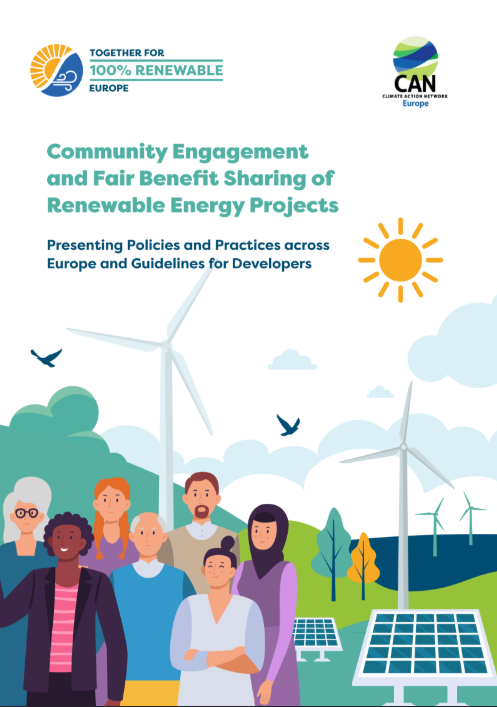
Moreover, communities need to see the direct, tangible, and proportionate benefits from renewable energy projects being built within their locality. These benefits can come in many forms, whether it’s through financial compensation, job creation, electricity discounts, educational as well as nature protection and restoration initiatives, upgrading public services and local amenities, or community benefit funds. Moreover, offering communities ownership stakes within new renewable projects can empower communities, leading to a higher long term support.
Yet, community engagement and benefit-sharing practices are inconsistent across EU Member States, with some countries having none or limited binding legislation for practices. This new report from CAN Europe, commissioned to eclareon and developed with the support of Eco-Union and CAN Europe members and partners, examines some of the good and bad practices across Europe when it comes to community engagement and benefit sharing for renewable energy projects.
The report provides guidelines on how renewable energy developers can improve their community engagement and benefit sharing practices to ensure cooperation from local stakeholders and boost public acceptance for renewables.
As part of the report, 11 case studies have been produced that present on the ground examples of renewable energy projects that showcase both good and back practices when it comes to community engagement and benefit-sharing.
You can check each of the case studies on this map ➡️
[display-map id=’26653′]
We have developed a checklist of KPIs for developers to improve the standard of community engagement and benefit-sharing practices across Europe.
There are 14+1 KPIs to trace the justness of community
engagement and benefit sharing with regard
to renewable energy projects.
The purpose of these KPIs is to ensure:
✅ Meaningful community engagement
✅ The fair distribution of benefits from local renewable energy projects
✅ Fostering genuine support for new renewable energy projects
Check out the full checklist.
Files: