-
Since the energy price crisis due to Russia’s invasion of Ukraine, households have been devoting a larger portion of their income to electricity, with prices increasing from an average of 22 cents per kWh in 2021, to almost 29 cents after the start of the war, and only marginally decreasing since then, according to Eurostat. Further increases or sustained high prices could provoke stronger social resistance.
Electricity prices in Europe remain strongly influenced by volatile global fossil gas markets. Recent geopolitical tensions, including the escalation of war in the Middle East, have once again triggered sharp increases in gas prices, exposing the continued vulnerability of Europe’s dependence on fossil gas and its power system to external shocks. Early March 2026 saw European gas prices rise beyond 60% following disruptions to energy supply routes and liquefied natural gas (LNG) production in the Gulf, and the cost of gas-fired electricity has increased by 55%. The impact on electricity prices will be greater the longer the conflict goes on, and will be most severe for countries with the heaviest reliance on gas power.
At the same time, substantial reductions in greenhouse gas emissions depend on electrifying transport and household heating. If households are forced to shoulder a disproportionate share of electricity system costs to favor industrial users, they may be discouraged from investing in electrification technologies like electric vehicles and heat pumps, which are crucial for the energy transition.

The EU’s electricity prices remain higher than in other regions of the world primarily due to the heavy reliance on imported fossil fuels, with fossil gas often setting the wholesale price. Unlike renewable generation, Europe’s storage capacity and demand-side flexibility have not developed at the same pace as variable renewables, leaving markets vulnerable to price spikes when gas prices rise. However, this is not uniform across the EU: countries like the Nordics and Spain, with abundant renewable and well-integrated markets, enjoy more competitive wholesale electricity prices.
Despite higher nominal prices, the EU is generally more energy-efficient relative to GDP than other major economies. This means that its competitiveness in electricity-intensive sectors is stronger than its headline prices suggest. Addressing price volatility and affordability requires continued investment in homegrown renewable energy, non-fossil flexibility and storage, grid modernisation and interconnections, and efficiency measures that allow Europe to combine climate ambition with resilient and competitive energy systems.
Electricity prices are shaped by several structural factors, which are all reflected in the bill. All components depend on policy choices made by governments.- Energy costs: This is what you pay for the electricity you actually use. Prices depend on wholesale electricity costs, which can vary by generation technology, supply and demand, infrastructure constraints, time of day and season or weather conditions.
- Network or grid fees: Charges for using the transmission and distribution networks that bring electricity to your home or business. This pays for maintaining poles, wires, and infrastructure.
- Taxes: These are added by governments along with various other charges including excise duties, VAT, and levies, some of them supporting renewable energy or energy efficiency, others have no link with energy, such as charges related to public broadcasting.
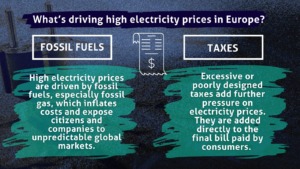
 High electricity prices are driven by imported fossil fuels, particularly fossil gas, which are the main driver of price volatility and spikes, continue to set the price in many countries, inflate costs across the system and expose citizens and companies to unpredictable global markets. Slow growth and modernisation of Europe’s electricity grids also contribute to high prices, as limited transmission and capacity leads to curtailment of cheap renewable energy and continued reliance on fossil backup plants.
Excessive or poorly designed taxes add further pressure to prices. These taxes are added directly to the final bill paid by consumers, and tax structures often inflate electricity costs unnecessarily. In many countries, electricity is taxed more heavily than fossil fuels like gas, which makes electrification less attractive.
 Under the Electricity Market Design, the merit order means that the cheapest available power plants are used first. This minimises overall system costs and supports cross-border trade. However, fossil gas-fired power plants, often the marginal price-setters, continue to drive wholesale electricity prices in many countries. As long as fossil fuels continue to set the marginal price, electricity prices will reflect fossil fuel price volatility. Reforming the merit order would not eliminate this structural link; it would merely obscure price signals and deter investment in renewable generation and flexibility, as well as create regulatory uncertainty and risk increasing electricity prices. By contrast, rapidly scaling up wind and solar, together with storage and demand-response, can reduce the influence of fossil fuels on electricity prices, helps bring down wholesale prices, and ultimately decouples electricity costs from gas price volatility. Spain, for example, has significantly reduced the link between electricity and gas prices by investing heavily in renewable energy.In the short term, the fastest way to lower electricity bills is through tax reform, specifically by rebalancing taxation away from electricity and toward fossil fuels. In many European countries, electricity carries a disproportionate share of policy costs, levies and VAT, while fossil gas and other fossil fuels remain comparatively lightly taxed. According to the IEA, in the first half of 2025, taxes and levies accounted for 28% of the average electricity prices for households, and was 2.2 times higher than the tax component on fossil gas, with particularly significant differences in Spain (4.2 times) and Germany (3.2 times).
Some governments recently took action to lower this ratio and reduce electricity prices through tax reforms. Examples include Austria and Denmark, which both reduced to the EU minimum level of 0.1 cents per kWh for 2026 onwards. Germany removed significant costs of legacy renewable support in 2021, leading to a reduction of the average annual household electricity prices by 16%, and the Netherlands has been gradually rebalancing tax on electricity since 2017.
Reforming tax structures is therefore a powerful lever that governments have today to lower power prices. Attention needs to be put on the effect of such reform, as rebalancing taxes to fossil fuels can impact vulnerable households. This calls for targeted and progressive solutions.
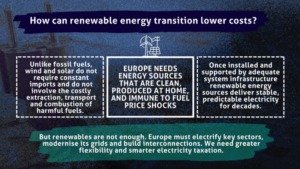
Renewable energy can lower energy costs through a combination of low operating costs, efficiency gains, and smart grid investments. Wind and solar have virtually zero fuel costs, so once built, they produce electricity at a fraction of the cost of fossil-fueled plants. This reduces the wholesale price of electricity and shields consumers from volatile fossil fuel markets. Evidence from the European Environment Agency shows that expanding renewables and electrification could reduce EU wholesale electricity prices by up to 57% by 2030, from around €91.7/MWh in 2023 to about €39.9/MWh, as renewable generation displaces gas-fired power and reduces exposure to imported fuels. Households and businesses can further lower bills by saving energy through efficiency measures, such as insulation, heat pumps, and smart demand management, which reduce consumption during high-price periods.Over the medium and long term, investing in grid expansion, storage, and flexible resources maximizes the value of renewables and stabilizes prices. Flexibility allows the system to balance supply and demand efficiently, preventing spikes when wind or solar output is low, and substitutes gas as the price setter. A 2025 system-cost analysis by WindEurope finds that a renewables-based energy system is the lowest-cost pathway for Europe, potentially saving up to €1.6 trillion by 2050 compared with slower transition scenarios, even when accounting for investments in grids, storage, and system flexibility. By combining low operating costs with smarter use of electricity and robust infrastructure, the renewable transition creates a more resilient energy system and delivers predictable, lower bills over time.
 The EU Emissions Trading System (ETS) places a carbon price on emissions from power plants and industry, increasing the operating costs of coal and gas plants. However the impact is minimal in the energy bill. Estimates show that carbon costs account for roughly 4-5% on average across the EU, with higher share in countries that rely more heavily on fossil fuels.
More importantly, the ETS has delivered significant benefits for Europe’s energy transition. By putting a price on carbon, it creates a strong incentive to replace coal and gas with cleaner technologies and to invest in renewable energy, efficiency, and electrification. Since its introduction, the ETS has helped cut emissions from covered sectors by around 50% compared with 2005 levels, particularly in the power sector where renewables have rapidly expanded. Revenues generated from the auctioning of carbon allowances also provide billions of euros each year to support innovation, clean technologies, and targeted support for households and industry during the transition.
The conflict in the Middle-East is already pushing up the prices of oil and gas, with European gas prices increasing by more than 60% in the first week after the attacks due to risks to key chokepoints like the Strait of Hormuz. In 2022, the loss of more than 100 billion cubic metres (bcm) of Russian pipeline gas drove European gas prices to unprecedented levels, with the Dutch TTF benchmark reaching around €340/MWh in August 2022. Current market conditions remain far below those extremes. While prices have recently shown volatility, rising sharply at the beginning of the week, the Dutch TTF benchmark is currently fluctuating around €50/MWh, indicating a much more stable situation than during the 2022 crisis. In addition, since 2022, the EU has diversified its gas supplies, increased gas storage and market safeguards. The scale of the energy price crisis however is tributary to the duration of the conflict and sustained impact on export disruptions and prices.Even so, short-term price spikes will impact households and industry, highlighting again Europe’s extreme dependency on imported fossil fuels. Accelerating homegrown renewables, non-fossil flexibility and storage, efficiency and flexible demand remains the solution to shield consumers, stabilise markets and maintain competitiveness while reducing dependence on volatile global energy markets.
Even so, short-term price spikes can impact households and industry, highlighting Europe’s ongoing exposure to imported fossil fuels. Accelerating renewables, non-fossil flexibility and storage, efficiency and flexible demand remains the next way to shield consumers, stabilise markets and maintain competitiveness while reducing dependence on volatile global energy markets.
Factsheet: How can Europe bring electricity prices down?