Why is the EU Grids Package Important?
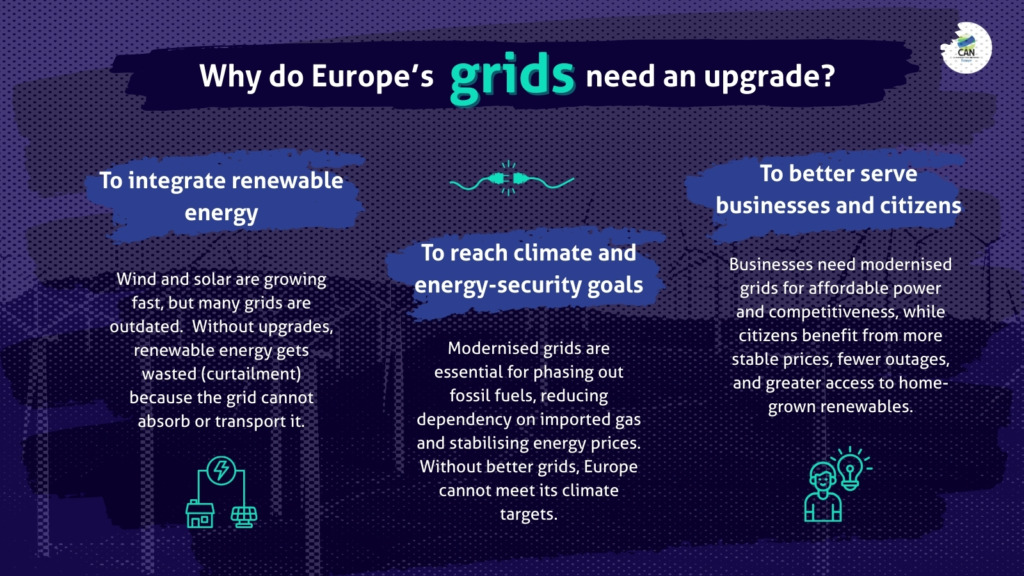
Having an adequate and modernised grid network is crucial for a stable, reliable and secure supply of electricity for homes, businesses and public services to function. The demand for electricity in Europe is forecasted to grow by 1.9% annually over the next two years and will continue to grow beyond that. This demand will be met by a growing supply of renewable energy sources such as solar and wind as fossil fuel sources such as coal and gas continue to be phased out.
Transmitting this larger electricity supply to cities and towns across Europe will require expanding Europe’s current grid capacity in order to avoid grid congestion and wasting additional supply generated by renewables. Moreover, to maximise the full use of Europe’s electricity supply, grids and electricity infrastructure need to become more flexible through the deployment of cross-border interconnections, energy storage (i.e batteries) and demand response technology. This is vital to ensure renewable electricity can be shifted during times of high production to regions or sectors in need of power, to avoid grid bottlenecks and lower overall energy costs across Europe.
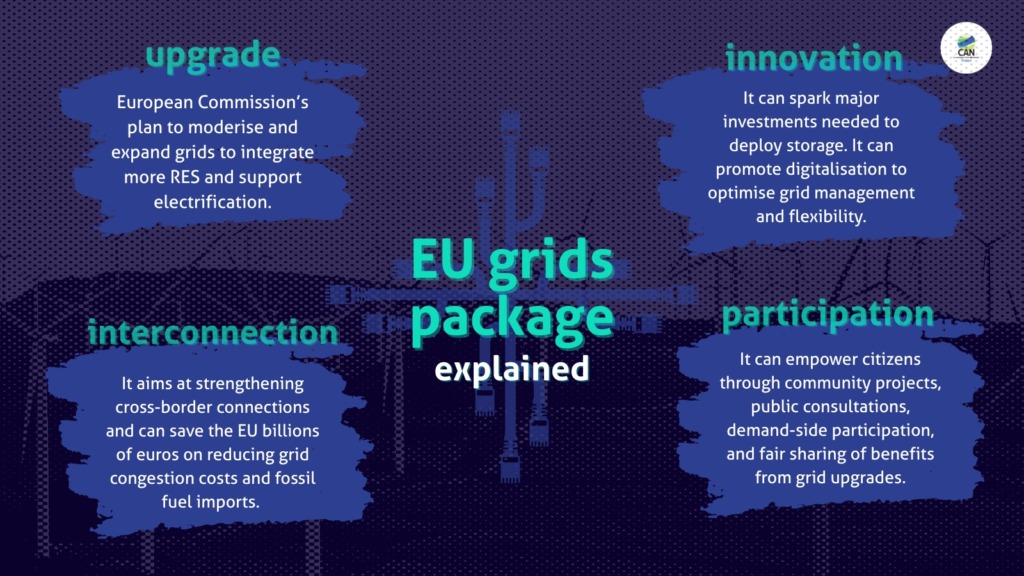
The EU Grids Package can be the catalyst needed to unlock the significant investments needed in expanding and digitising the EU’s grid infrastructure and deploying more energy storage technology and cross-border interconnections. This will ensure a more swift transition to a more resilient, decarbonised and fully renewable energy system while saving the EU billions of euro on reducing grid congestion costs and fossil fuel imports.
What is the current state of Europe’s grids?
As electricity generation from solar and wind continues to soar across Europe, its network of grids are struggling to keep pace with the additional supply of renewable energy. Europe’s cheapest energy source is being prevented from reaching homes and businesses due congested grids, connection queues and curtailment of renewable electricity. For instance, over 500GW of potential wind power in Europe sits in connection queues.
On top of wasting additional electricity supply, there is a cost in curtailing renewables which is passed onto the consumers. In 2024, a total of €7.2 billion across just seven countries was spent on the curtailment of renewables. These costs come from the need to pay renewable generators to curtail their energy in one part of the grid and to pay fossil plants to increase their outputs in another. If the business-as-usual scenario continues, the cost of grid management could increase from 26 billion euros in 2030 to a staggering 103 billion euros in 2040.
Overall, according to IEA’s publication on grids, around half of the EU grids were built more than 20 years ago, approximately 20% between 10 and 20 years ago, and 30% of the current grids over the last ten years.
How do we address this?
Modernising and expanding Europe’s grids will require significant investment. The EU foresees a massive investment need for electricity grids of €730 billion for distribution and €472 billion for transmission grid until 2040, while the energy regulators envisage a growth of grid investments between €75 and €100 billion per year.
For the EU27, the IEA assumes that the distribution grid would need to grow from 10.3 million kilometres in 2021 to 11 million kilometres (+6%) by 2030, and reach 14 million kilometres by 2050 (+35%). Ageing grids will need to be replaced, existing ones maintained, and substantial investment will be needed in new grid infrastructure, amounting up to €584 billion in investments until 2030.
According to the Paris Agreement Compatible 2.0 scenario results, as compared to 2021, the European power grid’s transmission capacity (EU25 & 12 TYNDP countries) would need to grow by at least +47% by 2030, reaching 404 GW. Furthermore, reaching a 634 GW grid capacity by 2035 means an increase of +131%. Finally, grids would need to reach 668 GW of capacity by 2040, indicating a total increase of +144% in their capacity, compared to current levels.
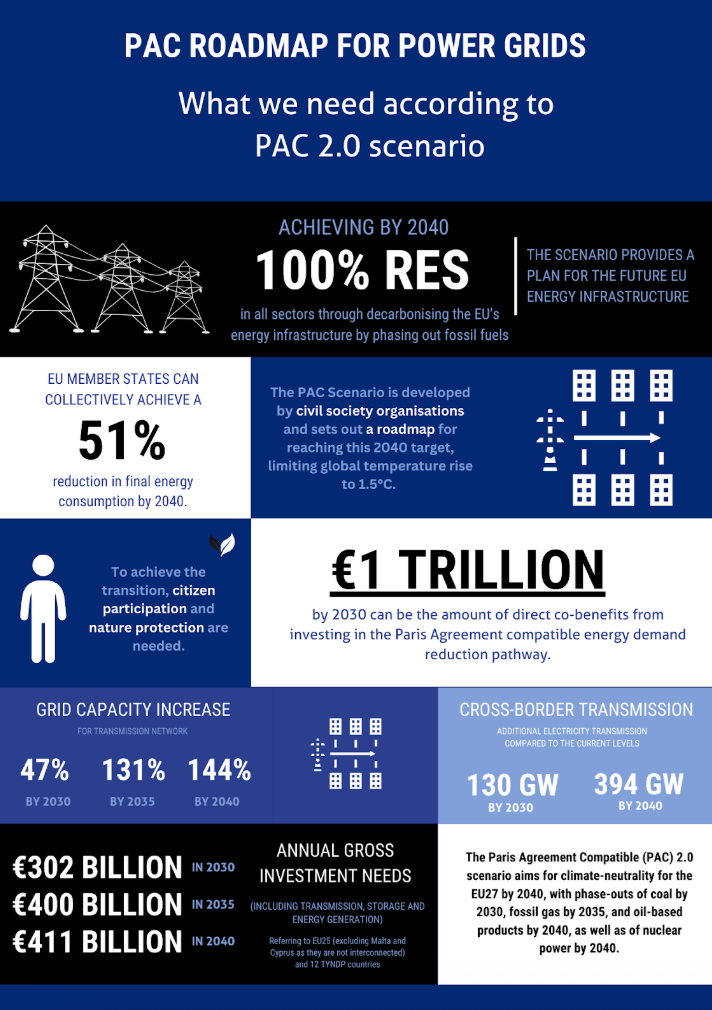
This increase in grid capacity will also need to coincide with a significant reduction in electricity demand. Without reducing energy demand leading to at least 20% energy savings by 2030 and to halving energy demand in 2040, the battle to electrify demand, coupled with renewable deployment needs, would be strenuous, delaying climate neutrality and fossil fuel phase-out, while increasing costs and the usage of materials, land, and water.
To optimise current electricity infrastructure, the EU should promote a flexible power system through an accelerated rollout of existing technology including energy storage, demand response, and interconnection. These flexible options can result in lower pressures on the power and fully maximise the growing abundance of renewable energy in Europe today. This will reduce the costs needed to pay renewable generators to curtail their energy in one part of the grid and to pay fossil plants to increase their outputs in another.
How is Europe doing in promoting a more flexible power system?
Interconnection
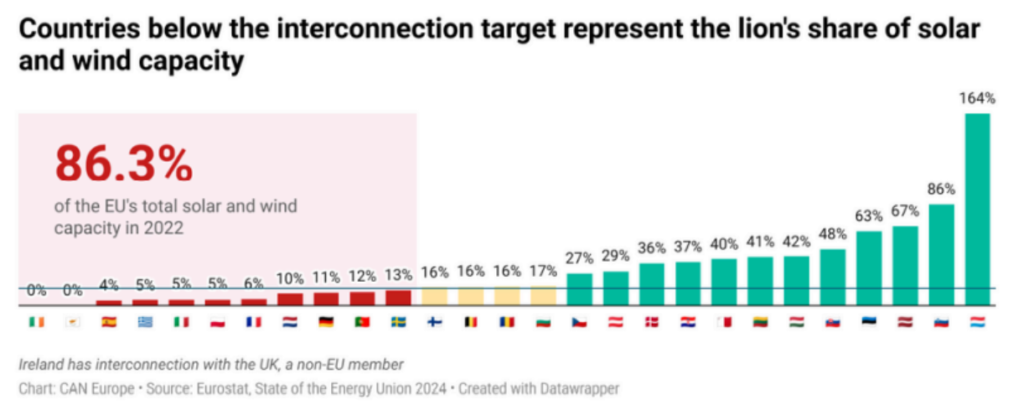
To support interconnection, the EU has set a target of at least 15% by 2030, meaning EU countries must have enough cross-border transmission capacity to facilitate the possibility of 15% of their electricity production within its territory to be transported to its neighbouring countries. In 2024, 16 member states have already met their interconnection targets well before 2030, easing the pressure off electrification. However the remaining 11 countries represent the vast majority of installed capacity of wind and solar, totaling 86.3% in 2022, suggesting significant work is required to increase the interconnection rate in these countries, while also increasing the supply of renewable power.
Interconnection, along with other flexibility options, are not only necessary to ensure the deployment of renewables across neighbouring countries and regions, but also to operate a reliable and safe electricity network, minimising blackouts and supporting reactivation. The blackout that occurred in Spain and Portugal provides a stark reminder on the need for interconnections. The Iberian Peninsula is an electricity island within the EU, due to its low interconnection ratio of only 2.8%. Delays to new interconnection with France is keeping Iberia isolated and more vulnerable.
Interconnectors play a vital role in ensuring electricity can be shifted during times of high production to regions in need of power, to avoid grid bottlenecks and lower overall energy costs across Europe.
Energy Storage
The main energy storage method in the EU is by far ‘pumped hydro’ storage, but battery storage is increasing. The revised Electricity Market Design calls for EU countries to conduct flexibility needs assessments, and to set a flexibility objective in their NECPs to meet these needs, with information on the levels of energy storage and demand response required to meet this objective.
In the PAC 2.0 pathway to achieving a 100% renewable energy system by 2040, home batteries reach 55 GW in 2035 and 65 GW in 2040 in the EU25 (Malta and Cyprus not included). Grid-scale batteries see a dramatic increase to 149 GW in 2030 and 225 GW in 2040. Pumped hydro storage (PHS), able to respond to demand and generation changes within minutes, is anticipated to remain at 48 GW across 2030, 2035 and 2040 for EU27.
Other storage technologies are advancing as well. Electric vehicles as batteries also will offer new storage capacity. In a future two-way energy system, with vehicle-to-grid adoption, thousands of EVs can act as a large, distributed energy system, as a service to the electricity grid, working in unison.
Demand response (demand-side flexibility)
Through the use of technologies such as smart meters, demand response allows consumers to actively manage and adjust their energy consumption patterns, either by reducing or shifting their demand, often in response to grid conditions or pricing signals. It incentives households to consume or store energy during periods of lower demand on the grid. This helps households to reduce their energy costs, enhance energy security and resilience. It also minimises grid congestion and constraint costs during periods of high demand.
Demand-side flexibility explained:
Who is paying for this investment?
Both a better leveraging of existing EU funds and new funding sources for investment in both the transmission and distribution network, alongside interconnectors and utility-scale storage, reduce renewable energy curtailment, and minimise the burden on consumers and households.
The program that provides funding to support the development and upgrading of cross-border energy infrastructure projects, Europe’s Connecting Europe Facility for Energy (CEF-E), is hardly making a dent into the levels of investment needed. Under the MFF 2021-2027 period, €5.84 billion has been allocated to CEF-E. In response to a call in 2024, only €750 million was awarded to cross-border electricity projects while €500 million was diverted towards hydrogen and CO2 infrastructure.
The current high interest rate environment not only makes it harder for system operators to raise private capital, but also can translate to higher network tariffs for consumers and industry, hitting the most vulnerable hard, dampening EU competitiveness, and stalling efforts to electrify demand.
More dedicated EU financing is needed towards cross-border electricity infrastructure. However, any increase in the budget must be limited to new electricity projects, not towards fossil gas or CO2. Low-interest loans from the European Investment Bank and State Aid not only help lower overall grid costs, but also provide confidence for co-investors to join projects. Efficient system planning is required to ensure only cost-effective solutions are financed.
Research commissioned by CAN Europe recommends the use of public financing in Europe to reduce grid costs and to help steer private investment towards grid infrastructure. An Austrian study by the consumer rights organisation highlights that state-backed financing of grids and longer payback periods can reduce total grid costs by 13.5%. While research from the UK highlights having low interest rates for grid investment can lead to lower household bills.
This should be done in conjunction with the promotion of progressive grid tariff design. An increase in grid tariffs to finance grid expansion and modernisation should not have negative impacts on lower-income households and the most vulnerable. Grid tariff design should share the costs more equitably, while incentivising the use of flexibility.
How do we reduce the impact of new electricity infrastructure on local communities and the environment?
Europe’s success to accelerate the rollout of renewable energy and grid development hinges on effectively engaging local communities hosting renewable energy infrastructure and sharing the benefits investors, developers, and operators reap from project development.
Local communities need to be involved prior to any project development and be able to see the benefits of new infrastructure, whether that be financial or through an understanding of benefits to the local environment, the climate and health.
Every new cable has an impact on nature, the local community, material usage and finance, but such impact can be minimized and mitigated, and the impact can be an overall positive one. If done in a coordinated manner, therefore, RES and electricity grids have the potential to effectively address the twin climate and biodiversity crises, and their deployment should go hand-in-hand with nature protection and restoration.
To share in the local value creation from renewables development, citizen and renewable energy community-led initiatives need special support to allow them to develop their own projects and to access the grid on an equal footing with professional actors. When new grid capacity comes online, capacity should be set aside for the connection of community energy groups. This supports the ecosystem of community energy, supporting lower bills for members, enhancing public support for the energy transition, and investment in local economies.
What could be the cost for Europe for not investing in its grid network?
European grid planning needs an overhaul to better support cross-border flows of renewable power and to build a system that is more resilient to disruptions – including blackouts and extreme weather – and actively anticipate the long-term impacts of climate change on energy infrastructure. Overall, the economic costs and social impacts of climate inaction are mounting.
According to ACER, the cost of managing grid congestion in 2023 in the EU was 4.2 billion euros, where grid congestion in the EU curtailed over 12 TWh of renewable electricity in 2023, causing additional 4.2 million tons of CO₂ emissions.
Looking at the future, the Joint Research Centre (JRC) foresees high levels of redispatch in 2040, a situation where the output of renewable and fossil plants is adjusted to solve grid congestion, often resulting in higher emissions, even in a scenario which foresees the total grid length in Europe increasing by more than a third, where 310 TWh of renewable energy could be curtailed because of grid congestion, which equals half the electricity production from wind and solar in the EU in 2022.
This could increase the cost of grid management from 26 billion euro in 2030 to a staggering 103 billion euro in 2040 if business-as usual continues, though the more ambitious scenario from the JRC which increased high levels of grid expansion would see costs rise from from 11 billion euro in 2030 to 34 billion euro in 2040.
Having an adequate and modernised grid network is crucial for a stable, reliable and secure supply of electricity for homes, businesses and public services to function. The demand for electricity in Europe is forecasted to grow by 1.9% annually over the next two years and will continue to grow beyond that. This demand will be met by a growing supply of renewable energy sources such as solar and wind as fossil fuel sources such as coal and gas continue to be phased out.
Transmitting this larger electricity supply to cities and towns across Europe will require expanding Europe’s current grid capacity in order to avoid grid congestion and wasting additional supply generated by renewables. Moreover, to maximise the full use of Europe’s electricity supply, grids and electricity infrastructure need to become more flexible through the deployment of cross-border interconnections, energy storage (i.e batteries) and demand response technology. This is vital to ensure renewable electricity can be shifted during times of high production to regions or sectors in need of power, to avoid grid bottlenecks and lower overall energy costs across Europe.
The EU Grids Package can be the catalyst needed to unlock the significant investments needed in expanding and digitising the EU’s grid infrastructure and deploying more energy storage technology and cross-border interconnections. This will ensure a more swift transition to a more resilient, decarbonised and fully renewable energy system while saving the EU billions of euro on reducing grid congestion costs and fossil fuel imports.
As electricity generation from solar and wind continues to soar across Europe, its network of grids are struggling to keep pace with the additional supply of renewable energy. Europe’s cheapest energy source is being prevented from reaching homes and businesses due congested grids, connection queues and curtailment of renewable electricity. For instance, over 500GW of potential wind power in Europe sits in connection queues.
On top of wasting additional electricity supply, there is a cost in curtailing renewables which is passed onto the consumers. In 2024, a total of €7.2 billion across just seven countries was spent on the curtailment of renewables. These costs come from the need to pay renewable generators to curtail their energy in one part of the grid and to pay fossil plants to increase their outputs in another. If the business-as-usual scenario continues, the cost of grid management could increase from 26 billion euros in 2030 to a staggering 103 billion euros in 2040.
Overall, according to IEA’s publication on grids, around half of the EU grids were built more than 20 years ago, approximately 20% between 10 and 20 years ago, and 30% of the current grids over the last ten years.
Modernising and expanding Europe’s grids will require significant investment. The EU foresees a massive investment need for electricity grids of €730 billion for distribution and €472 billion for transmission grid until 2040, while the energy regulators envisage a growth of grid investments between €75 and €100 billion per year.
For the EU27, the IEA assumes that the distribution grid would need to grow from 10.3 million kilometres in 2021 to 11 million kilometres (+6%) by 2030, and reach 14 million kilometres by 2050 (+35%). Ageing grids will need to be replaced, existing ones maintained, and substantial investment will be needed in new grid infrastructure, amounting up to €584 billion in investments until 2030.
According to the Paris Agreement Compatible 2.0 scenario results, as compared to 2021, the European power grid’s transmission capacity (EU25 & 12 TYNDP countries) would need to grow by at least +47% by 2030, reaching 404 GW. Furthermore, reaching a 634 GW grid capacity by 2035 means an increase of +131%. Finally, grids would need to reach 668 GW of capacity by 2040, indicating a total increase of +144% in their capacity, compared to current levels.
This increase in grid capacity will also need to coincide with a significant reduction in electricity demand. Without reducing energy demand leading to at least 20% energy savings by 2030 and to halving energy demand in 2040, the battle to electrify demand, coupled with renewable deployment needs, would be strenuous, delaying climate neutrality and fossil fuel phase-out, while increasing costs and the usage of materials, land, and water.
To optimise current electricity infrastructure, the EU should promote a flexible power system through an accelerated rollout of existing technology including energy storage, demand response, and interconnection. These flexible options can result in lower pressures on the power and fully maximise the growing abundance of renewable energy in Europe today. This will reduce the costs needed to pay renewable generators to curtail their energy in one part of the grid and to pay fossil plants to increase their outputs in another.
Interconnection
To support interconnection, the EU has set a target of at least 15% by 2030, meaning EU countries must have enough cross-border transmission capacity to facilitate the possibility of 15% of their electricity production within its territory to be transported to its neighbouring countries. In 2024, 16 member states have already met their interconnection targets well before 2030, easing the pressure off electrification. However the remaining 11 countries represent the vast majority of installed capacity of wind and solar, totaling 86.3% in 2022, suggesting significant work is required to increase the interconnection rate in these countries, while also increasing the supply of renewable power.
Interconnection, along with other flexibility options, are not only necessary to ensure the deployment of renewables across neighbouring countries and regions, but also to operate a reliable and safe electricity network, minimising blackouts and supporting reactivation. The blackout that occurred in Spain and Portugal provides a stark reminder on the need for interconnections. The Iberian Peninsula is an electricity island within the EU, due to its low interconnection ratio of only 2.8%. Delays to new interconnection with France is keeping Iberia isolated and more vulnerable.
Interconnectors play a vital role in ensuring electricity can be shifted during times of high production to regions in need of power, to avoid grid bottlenecks and lower overall energy costs across Europe.
Energy Storage
The main energy storage method in the EU is by far ‘pumped hydro’ storage, but battery storage is increasing. The revised Electricity Market Design calls for EU countries to conduct flexibility needs assessments, and to set a flexibility objective in their NECPs to meet these needs, with information on the levels of energy storage and demand response required to meet this objective.
In the PAC 2.0 pathway to achieving a 100% renewable energy system by 2040, home batteries reach 55 GW in 2035 and 65 GW in 2040 in the EU25 (Malta and Cyprus not included). Grid-scale batteries see a dramatic increase to 149 GW in 2030 and 225 GW in 2040. Pumped hydro storage (PHS), able to respond to demand and generation changes within minutes, is anticipated to remain at 48 GW across 2030, 2035 and 2040 for EU27.
Other storage technologies are advancing as well. Electric vehicles as batteries also will offer new storage capacity. In a future two-way energy system, with vehicle-to-grid adoption, thousands of EVs can act as a large, distributed energy system, as a service to the electricity grid, working in unison.
Demand response (demand-side flexibility)
Through the use of technologies such as smart meters, demand response allows consumers to actively manage and adjust their energy consumption patterns, either by reducing or shifting their demand, often in response to grid conditions or pricing signals. It incentives households to consume or store energy during periods of lower demand on the grid. This helps households to reduce their energy costs, enhance energy security and resilience. It also minimises grid congestion and constraint costs during periods of high demand.
Demand-side flexibility explained:
Both a better leveraging of existing EU funds and new funding sources for investment in both the transmission and distribution network, alongside interconnectors and utility-scale storage, reduce renewable energy curtailment, and minimise the burden on consumers and households.
The program that provides funding to support the development and upgrading of cross-border energy infrastructure projects, Europe’s Connecting Europe Facility for Energy (CEF-E), is hardly making a dent into the levels of investment needed. Under the MFF 2021-2027 period, €5.84 billion has been allocated to CEF-E. In response to a call in 2024, only €750 million was awarded to cross-border electricity projects while €500 million was diverted towards hydrogen and CO2 infrastructure.
The current high interest rate environment not only makes it harder for system operators to raise private capital, but also can translate to higher network tariffs for consumers and industry, hitting the most vulnerable hard, dampening EU competitiveness, and stalling efforts to electrify demand.
More dedicated EU financing is needed towards cross-border electricity infrastructure. However, any increase in the budget must be limited to new electricity projects, not towards fossil gas or CO2. Low-interest loans from the European Investment Bank and State Aid not only help lower overall grid costs, but also provide confidence for co-investors to join projects. Efficient system planning is required to ensure only cost-effective solutions are financed.
Research commissioned by CAN Europe recommends the use of public financing in Europe to reduce grid costs and to help steer private investment towards grid infrastructure. An Austrian study by the consumer rights organisation highlights that state-backed financing of grids and longer payback periods can reduce total grid costs by 13.5%. While research from the UK highlights having low interest rates for grid investment can lead to lower household bills.
This should be done in conjunction with the promotion of progressive grid tariff design. An increase in grid tariffs to finance grid expansion and modernisation should not have negative impacts on lower-income households and the most vulnerable. Grid tariff design should share the costs more equitably, while incentivising the use of flexibility.
Europe’s success to accelerate the rollout of renewable energy and grid development hinges on effectively engaging local communities hosting renewable energy infrastructure and sharing the benefits investors, developers, and operators reap from project development.
Local communities need to be involved prior to any project development and be able to see the benefits of new infrastructure, whether that be financial or through an understanding of benefits to the local environment, the climate and health.
Every new cable has an impact on nature, the local community, material usage and finance, but such impact can be minimized and mitigated, and the impact can be an overall positive one. If done in a coordinated manner, therefore, RES and electricity grids have the potential to effectively address the twin climate and biodiversity crises, and their deployment should go hand-in-hand with nature protection and restoration.
To share in the local value creation from renewables development, citizen and renewable energy community-led initiatives need special support to allow them to develop their own projects and to access the grid on an equal footing with professional actors. When new grid capacity comes online, capacity should be set aside for the connection of community energy groups. This supports the ecosystem of community energy, supporting lower bills for members, enhancing public support for the energy transition, and investment in local economies.
European grid planning needs an overhaul to better support cross-border flows of renewable power and to build a system that is more resilient to disruptions – including blackouts and extreme weather – and actively anticipate the long-term impacts of climate change on energy infrastructure. Overall, the economic costs and social impacts of climate inaction are mounting.
According to ACER, the cost of managing grid congestion in 2023 in the EU was 4.2 billion euros, where grid congestion in the EU curtailed over 12 TWh of renewable electricity in 2023, causing additional 4.2 million tons of CO₂ emissions.
Looking at the future, the Joint Research Centre (JRC) foresees high levels of redispatch in 2040, a situation where the output of renewable and fossil plants is adjusted to solve grid congestion, often resulting in higher emissions, even in a scenario which foresees the total grid length in Europe increasing by more than a third, where 310 TWh of renewable energy could be curtailed because of grid congestion, which equals half the electricity production from wind and solar in the EU in 2022.
This could increase the cost of grid management from 26 billion euro in 2030 to a staggering 103 billion euro in 2040 if business-as usual continues, though the more ambitious scenario from the JRC which increased high levels of grid expansion would see costs rise from from 11 billion euro in 2030 to 34 billion euro in 2040.
Resources:
-
CAN Europe’s response to European Grids Package Call for Evidence.
-
Wired for Climate Neutrality – A Paris Agreement Compatible (PAC) roadmap for power grids.
-
100% RES-based electrification: the Electrification Action Plan Civil Society Wants to See.