Insights from existing feminist foreign policies
According to the Centre for Feminist Foreign Policy (CFFP), Sweden’s adoption of a Feminist Foreign Policy (FFP) in 2014 “set in motion a growing movement”, with France, Spain, Mexico and Canada adopting FFPs. The Netherlands have recently embarked on a process to develop an FFP as well as a feminist development policy. The German Federal Foreign Office released its guidelines “Shaping feminist foreign policy” and the Federal Ministry for Economic Cooperation and Development (BMZ) which is by far the larger player when it comes to climate finance, recently presented its strategy for a feminist development policy (so far only in a German version), on 1 March 2023. Many countries with feminist foreign policies are in one way or the other applying the “triple R” approach:- Rights: promote all women’s and girls’ full enjoyment of human rights
- Representation: promote women’s participation and influence in decision- making processes at all levels
- Resources: work to ensure that resources are allocated to promote gender equality and equal opportunities for all women and girls to enjoy human rights
Climate-just Feminist Foreign Policies: more than a climate tick box
However, it has to be noted that it is essential that any Feminist Foreign Policy is committed to climate justice and addressing the climate crisis overall. It is not just one element, but it has to be at the core and one of the key areas for any Feminist Foreign Policy. Because the same elements that exploit women and any politically marginalized groups are also at the core of exploiting this planet and our environment. So the connection is pretty clear. At the same time it is exactly these multiple marginalized groups, predominantly Black, Indigenous and Women of Color, youth and elders that lead the feminist fight against the climate crisis. So any FFP that is true to its feminist elements must embrace and truly promote that.Lack of a Feminist Foreign Policy approach to EU’s climate and energy diplomacy
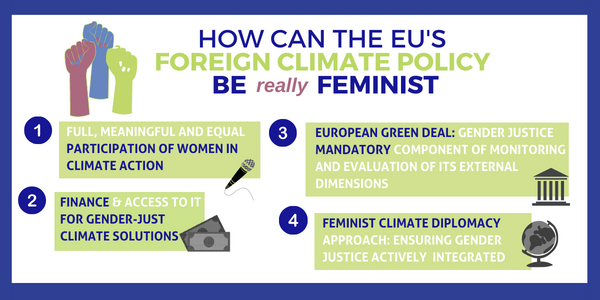
In its recent EU Council meeting on 20 February, the EU’s Foreign Affairs ministers failed to adopt climate and energy diplomacy conclusions, which are regarded as a key tool of the EU’s approach to the external dimensions of the European Green Deal. CAN Europe presented key recommendations in advance of the meeting. Some media reports suggested this was mainly due to controversies over the inclusion of nuclear in the context of hydrogen promotion. The matter may be taken up during the next ministers’ meeting on 20 March. Whether the conclusions would also indicate the EU stepping up on gender equality and feminist foreign policy terms remains to be seen. The climate and energy diplomacy conclusions are a key policy instrument that, unfortunately, in the last years (2019-2022) reflected more of a standstill in this area, with repetitive, vague language provisions merely committing to “continue to uphold, promote and protect gender equality and women’s empowerment.” Of course, whether the EU embraces a comprehensive approach to strengthening feminist foreign policy elements in its climate and energy diplomacy does not only depend on what ends up in the Foreign Affairs Council conclusions. Instruments such as the 3rd Gender Action Plan (GAP) are important starting points, but yet fail to be fully and consistently applied. CAN Europe suggested for inclusion in the current EU climate and energy diplomacy conclusions the following key elements as starting points to gradually move to feminist climate and diplomacy approach:- committing to “increase the full, meaningful and equal participation of women in climate action”, and commit to increased action to achieve this;
- increasing finance for, and access to, gender-just climate solutions led by grassroots and feminist organisations in the Global South;
- ensuring that gender justice is a mandatory component of monitoring and evaluating the EU’s progress on the external dimensions of the European Green Deal;
- ensuring gender justice is actively embedded in and integrated into all climate diplomacy work undertaken by the European External Action Service (EEAS).