 What has the EU done against the climate emergency between 2017 and now? The EU has increased its 2030 climate target – it now aims at reducing its net greenhouse gas emissions by 55% – and the bloc committed to be climate neutral by 2050. However, this level of ambition is far from guaranteeing a safe future, and far from what the EU’s fair contribution should be to keep global warming to 1.5°C, as set out in the Paris Agreement. Any failure to limit global heating within this threshold severely undermines and threatens people’s safety and their fundamental rights. This is why more and more people are standing for their right to live on a safe planet. The above mentioned case is only one in many which illustrates the trend.
A crucial hearing in a landmark case
The European Court of Human Rights is yet to adopt a judgement on climate change, which makes this Portuguese Youth case a landmark one. One should imagine how the courtroom will look like during this 27 September’s hearing. On the one side, six young people. On the other side, 32 national European governments: all 27 EU member states, plus the United Kingdom, Norway, Switzerland, Russia and Turkey. In the middle, 17 judges whose task is to decide on one of the biggest issues of our time. At the center of the debate, the question of whether the young plaintiffs are victims of human rights violations. They argue that several of their rights under the European Convention of Human Rights are being violated because of governments’ failure to take sufficient action, including their right to life (Article 2), to privacy and family life (Article 8) and to be free from discrimination (Article 14). The case was filed in September 2020, making it the first climate case with the European Court of Human Rights. The Court fast-tracked the case based on its “importance and urgency” and then referred it to its Grand Chamber. Only a tiny fraction of the most exceptionally important cases are sent to the Grand Chamber in such a manner.What’s the European Union’s role in the case?
The European Union has been granted a voice in this hearing, given its role in the coordination of the climate policy of 27 out of the 32 defendant States. Hence, the European Commission was accepted as a third-party intervener and was asked to provide the Court with information to assist it in reaching its decision. The main objective of the European Commission intervention is to demonstrate “the adequacy of the EU climate policy which implements the EU’s obligations under the Paris Agreement”. The European Commission also points out that it has “stepped up its emission reduction target for 2030 in a responsible manner” by adopting an objective of reducing its net GHG emissions by 55% and “aims to become climate neutral by 2050”. As a consequence, the EU presents itself as a “global standard-setter”. This is precisely where the shoe pinches. In their arguments, the young applicants rely on scientific evidence showing that if every country in the world reduced their emissions with the same level of ambition as the accused 32 countries (including the 27 EU Member States), global warming would reach 3°C or even worse within their lifetime. Is 3°C global warming the standard that the EU aims to set for the world? As a reminder, the IPCC explained that passing a 1.5°C temperature increase would already be catastrophic, considering natural tipping points; and the IPCC continuously stresses that “every increment of global warming will intensify multiple and concurrent hazards”.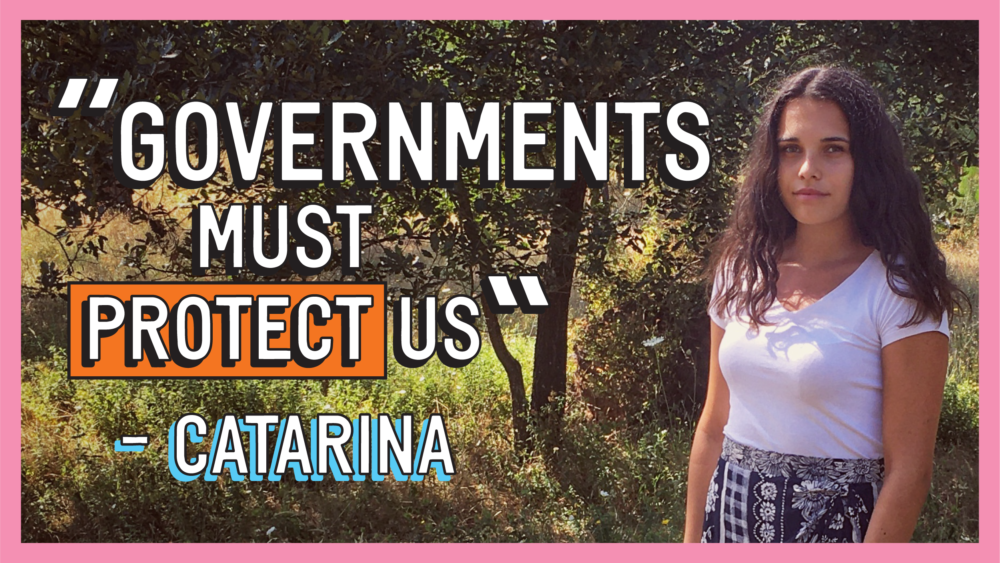
Civil society’s response
CAN Europe and other civil society organisations have also been granted a status of third-party interveners. Several elements were raised in support of the applicants’ arguments in our December 2022 written observations, including that the Court should develop criteria to capture the complex causal chain between the emission of greenhouse gases and the concrete violation of human rights. We also argued that the 1.5°C limit set up in the Paris Agreement is a binding yardstick to calculate states’ fair shares in the global effort to achieve the Agreement’s objectives. More generally, CAN Europe supported the applicants’ arguments that dangerous climate change is a violation of fundamental human rights. Whatever the outcome of the Portuguese Youth case, the EU will have to answer several related questions in the near future. In August 2023, CAN Europe and the Global Legal Action Network submitted a legal request to the European Commission to urgently up EU climate ambition by 2030. The request underlines that the EU´s overall climate ambition remains alarmingly off-track with its fair share to the 1.5°C target of the Paris Agreement. It is also a call on EU decision-makers to accelerate climate action and go beyond the inadequate level of ambition of the “Fit for 55” legislative package, thus enabling steep emission reductions in the short-term and achieving at least -65% gross emission reductions by 2030.