Bruxelles, 17 December 2025 – Climate Action Network (CAN) Europe releases today its assessment of the Western Balkan countries’ Reform Agendas adopted under the EU’s Reform and Growth Facility. The assessment shows that while the adopted Reform Agendas provide a structured framework for a sustainable and digital transition, actual implementation is uneven and significant risks remain. The Facility represents a unique opportunity to accelerate the alignment of the region with EU climate and energy goals, yet governments must act promptly to turn plans into tangible outcomes.
Uneven progress on climate and energy reforms
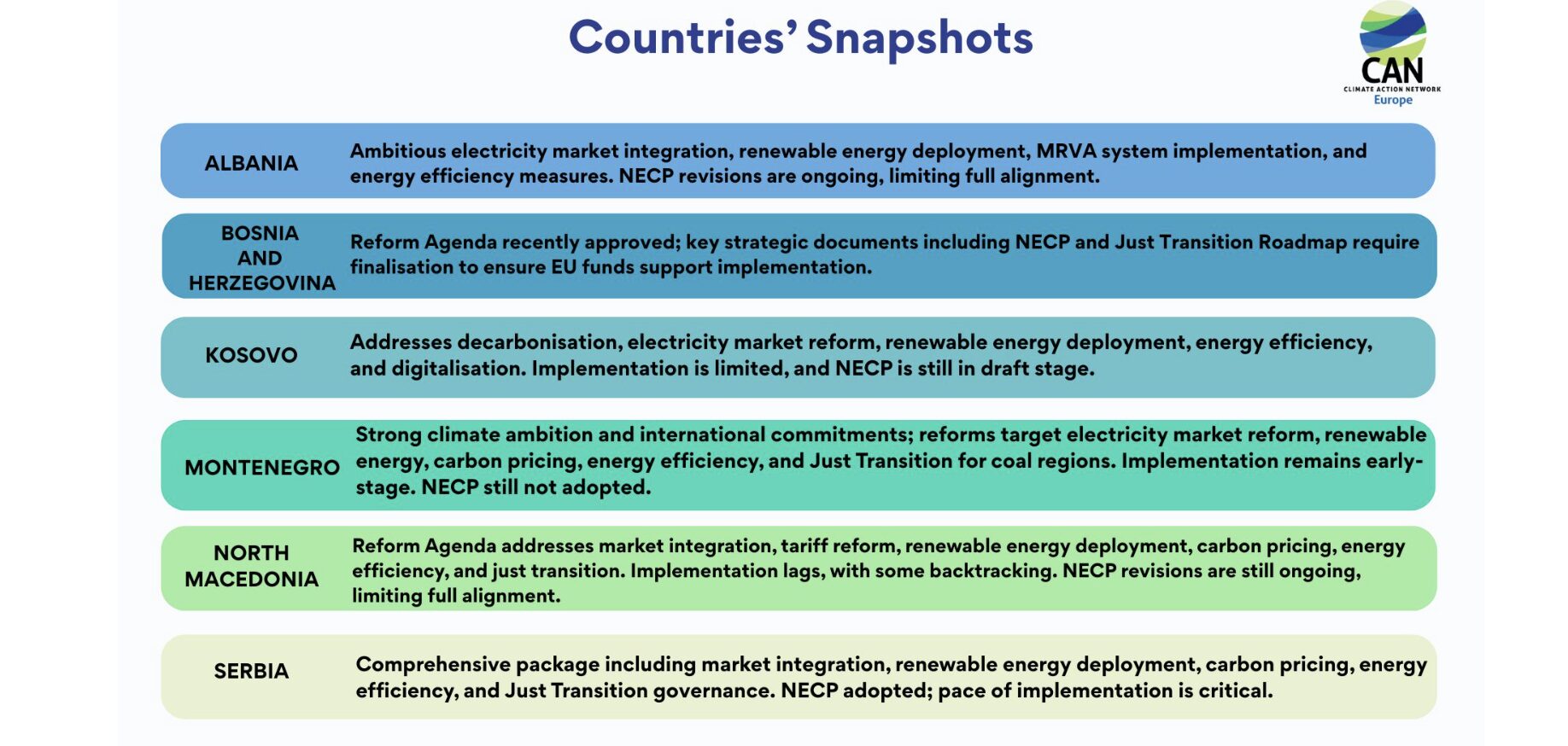
CAN Europe’s assessment finds that all six Reform Agendas embed, to varying degrees, the priorities of existing or drafted NECPs. Most emphasise renewable energy deployment, energy efficiency, market integration, and preparation for carbon pricing. However, the level of ambition and specificity differs significantly across the region, and while the alignment with EU rules is positive, reforms remain largely legislative or preparatory, with most deliverables postponed to 2026–2029.
Social aspects of the transition are far less developed. Targets for vulnerable energy consumers and just transition mechanisms remain unclear. “The Western Balkans stand at a critical juncture,” says Frosina Antonovska, Climate and Energy Policy Coordinator, CAN Europe. “The Reform and Growth Facility can unlock a just and sustainable transition, but only if governments deliver the reforms they have committed to. The EU must also ensure strong monitoring, transparency, and accountability for the use of public funds.”
Key findings:
- Conditional funding drives reforms, but results are limited so far: Across the region, out of 50 planned steps for climate and energy reforms, only 9 have been completed by the end of 2025 (excluding Bosnia and Herzegovina’s reform agenda that was approved just last week). €26.16 million of EU support has been released for just transition measures, highlighting the potential of the Facility to unlock climate action, but also close the gap between ambition and delivery.
- NECP alignment is inconsistent: Despite progress in preparing Reform Agendas, the Western Balkans still lag on their NECP obligations. Under the Energy Community Governance Regulation, all Contracting Parties were required to submit updated, credible, and model-based NECPs that outline how they will deliver 2030 climate and energy targets. However, no Western Balkan country, apart from Serbia, has adopted a new NECP in 2024–2025. While some have released drafts or launched public consultations, the plans remain overdue. Implementation progress reports due in March 2025 were also not submitted.
- Implementation is largely preparatory: Most reforms remain at legislative or institutional stages, with infrastructure deployment, carbon pricing, and energy efficiency investments back-loaded toward 2026–2029. Without acceleration, the region risks missing its 2030 targets.
- Public participation is largely absent: Across all six countries, climate and energy reforms are mainly presented in administrative or institutional terms, with limited social dialogue. Meaningful inclusion of stakeholders and wider public engagement is essential for a just transition and societal legitimacy.
- Regional risks persist: Limited administrative and technical capacity, permitting and financing bottlenecks, sectoral vested interests in coal and hydro, and complex governance structures (especially in Bosnia and Herzegovina) may delay implementation.
CAN Europe recommendations
- Accelerate implementation: Governments must pace up legislative and preparatory steps, and move towards tangible investments and infrastructure deployment.
- Prioritise NECP alignment: Reform Agendas should be fully integrated with NECPs, Nationally Determined Contributions (NDCs), and National Adaptation Plans (NAPs) and long-term climate strategies to maximise the Facility’s impact.
- Ensure meaningful public participation: All reforms should incorporate stakeholder engagement, social dialogue, and transparency to support just transitions.
- Address structural bottlenecks: Administrative, technical, and financing limitations must be overcome to achieve timely reform execution.
- Use EU funding strategically: Conditional funding under the Facility should continue to incentivise compliance, while governments must ensure reforms are implemented promptly to avoid missed opportunities.
The Reform and Growth Facility presents a rare opportunity for Western Balkan countries to accelerate their just energy transition, advance renewable energy deployment, boost energy efficiency, and mobilise investments for a climate-resilient economy. However, timely implementation remains a major challenge. Success will depend on governments accelerating reforms, aligning national legislation with EU and Energy Community rules, and operationalising NECPs, NDCs, and long-term climate strategies. Equally crucial is the meaningful involvement of stakeholders and the wider public, ensuring that reforms are not only implemented, but embraced as part of a socially just and transparent transition.
A decade after the Paris Agreement, governments in the region must step up in placing a much stronger emphasis on credible climate mitigation and adaptation targets, as well as just transition. Without urgent action, the Reform Agendas risk becoming another missed opportunity for climate progress in the region.
ACCESS THE FULL ASSESSMENT REPORT IN ENGLISH
CONTACTS:
Frosina Antonovska, Climate and Energy Policy Coordinator for the Western Balkans
frosina.antonovska@caneurope.org
Eleonora Allena, Communication Coordinator for the Western Balkans
eleonora.allena@caneurope.org
Note to editors
The analysis and findings presented in this press release are based on information publicly available up to Friday, 12 December 2025. Montenegro adopted its National Energy and Climate Plan (NECP) on 16 December 2025, after the cut-off date for this assessment, and this development is therefore not reflected in the report.
The European Commission launched the Reform and Growth Facility 2024–2027 to support the implementation of the new Growth Plan for the Western Balkans. The Facility entered into force in May 2024 and links financial support directly to reform progress. Each beneficiary was required to prepare a Reform Agenda, assessed by the Commission and approved by the Council. At least half of the funding will be channelled into investments through the Western Balkans Investment Framework, while the remainder depends on countries’ progress in agreed reforms. This shift to performance-based financing was widely welcomed as a step that can accelerate EU alignment. Importantly, Reform Agendas must also demonstrate coherence with other regional policy processes, including National Energy and Climate Plans, a key element of the Energy Community acquis.