Written by: Isabelle Brachet, Senior Fiscal Policy Coordinator at Climate Action Network Europe
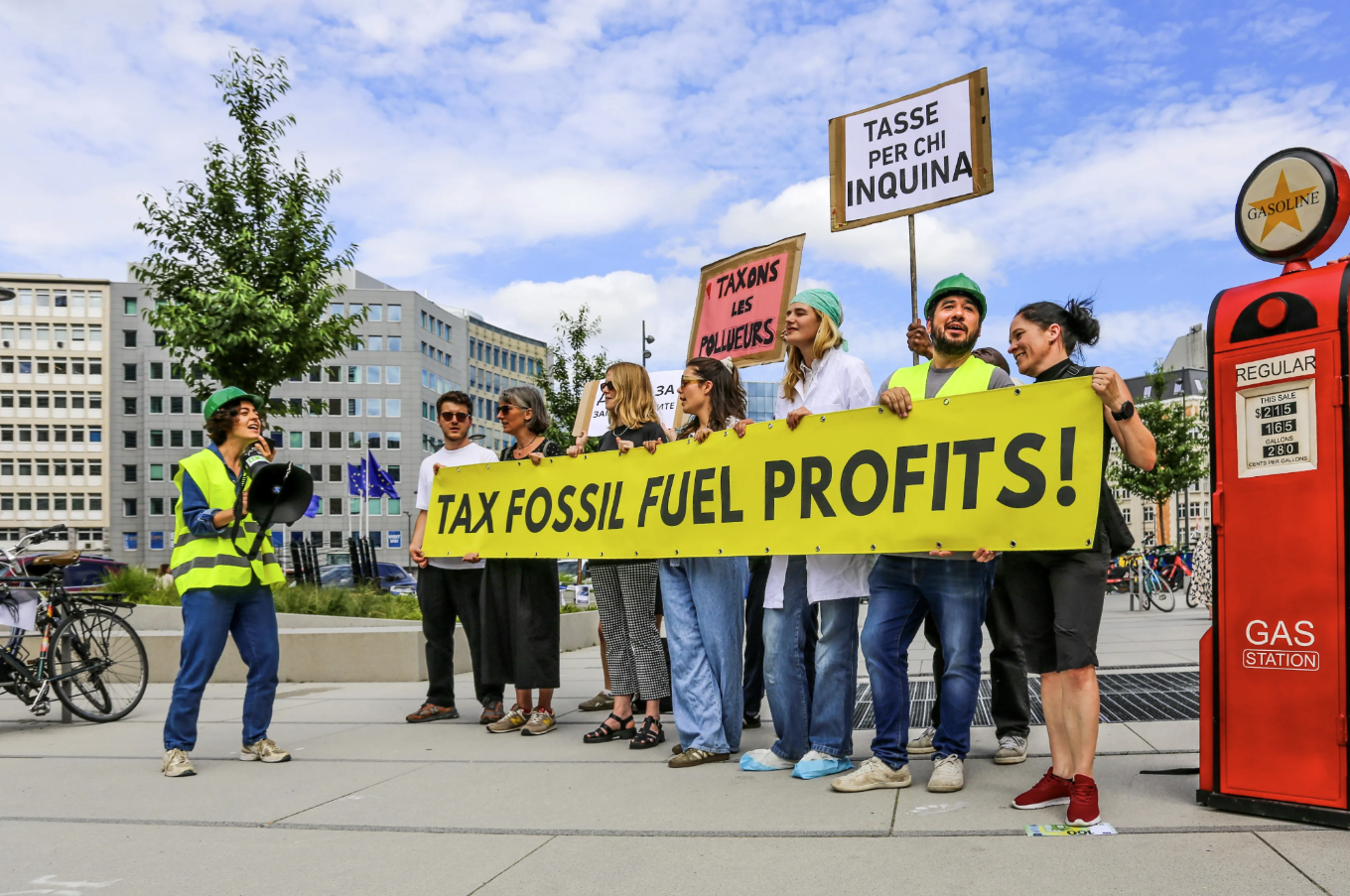
While the European Finance Ministers are meeting in Luxembourg, the taxation of fossil fuel profits is finally making its way to the political leaders’ agenda.
The renewed interest in taxation is understandable: anxiety is rising among decision-makers because oil and gas prices remain high and winter will increase gas demand as people need to heat their homes. The war on Iran, restrictions on the Strait of Hormuz, reduced LNG supply, and low gas storage levels will push prices higher, with the risk of a domino effect on the whole economy – known as fossilflation.
As the European Commissioner for Energy Dan Jørgensen bluntly said: “We have millions of citizens who basically, at the end of the month, will have to choose between freezing or being hungry because they cannot pay the bills”.
Taxing the exceptional war-driven profits made by coal, oil and gas companies would help raise the money needed to support people and companies during the winter and beyond.
There are now less than three months left for the 27 EU Member States to agree on an EU framework for a tax on fossil fuel windfall profits of 2026. The tax needs to be adopted by the EU before the end of the year, and ideally swiftly enacted at the national level, as retroactive taxation is heavily restricted in most countries. It will be challenging, but it is still possible.
Why is it challenging? Because we may need unanimous support from the 27 EU Member States. The 2022 windfall profit tax on fossil fuel companies was adopted only with a majority vote, while under normal conditions, taxation requires unanimity. A majority vote is possible only in case “severe difficulties arise in the supply of certain products, notably in the area of energy” – as article 122 of the EU Founding Treaties states – which was definitely the case when Russia attacked Ukraine and Europe had to make do without Russian oil and gas.
However, fossil fuel companies launched a series of lawsuits against the 2022 tax, arguing notably that article 122 was not a valid legal basis. The Court of Justice of the EU is expected to rule on the validity of this legal basis next year only. Meanwhile, governments by and large fear adopting a similar tax on the same legal basis again. Fossil fuel companies’ legal suits reached their goal: they created a chilling effect, as many governments do not dare to tax them again. In addition, the European Commission seems to consider that the situation is not yet severe enough to justify a majority vote. For all these reasons, and rightly or not, the Commission considers that unanimity is needed. And it is always difficult to reach.
Some countries such as Hungary, Romania and Portugal already implement a national windfall profit tax. This shows that it is possible to move ahead at the national level without waiting for an EU initiative. However, an EU framework would bring much value on two accounts.
First, a uniform framework would limit profit shifting by fossil fuel companies between different EU countries, which is a common practice by multinational companies to avoid taxes. Second, an EU framework would, as in 2022, direct the use of proceeds from the tax towards households and companies most in need, helping them to move away from fossil fuels.
So far, to respond to the current fossil fuel price crisis, many Member States preferred to adopt untargeted subsidies, such as general energy excise duty or VAT cuts, which weigh heavily on public budgets, benefit rich and poor indiscriminately and do not help in ending the EU’s fossil fuel dependence. Instead, the EU-wide tax framework could direct the new income to subsidies for heat pumps, investments in public transport, social leasing of electric vehicles and other targeted measures that accelerate ending the costly fossil fuel dependency and shield households and firms from volatile energy prices not only today, but also tomorrow.
There are three months left to tax the 2026 war profits of the fossil fuel companies. The EU governments must now roll up their sleeves for a quick fix before the end of the year. It can be straightforward if there is a political will to put protecting EU citizens at the forefront.
Taxing the windfall profits is the first and most urgent step, but in the longer term, the EU needs a stable tax framework for fossil fuel companies, beyond exceptional war-driven profits. This is necessary to help shift investments away from fossil fuels into what the EU really needs: renewable energy and renewables-based electrification, related storage capacity and modern electricity grids. The Spanish government recently proposed a permanent EU tax on fossil fuel profits to finance climate adaptation and the growing damages caused by the climate crisis. After the band-aid on windfall profits, this is the way forward: ensuring that polluters pay.
Profits of the fossil fuel industry have been colossal for years, a trend further aggravated by the closure of the Hormuz Strait, from which they directly benefit. Rising energy prices due to our heavy dependence on fossil fuels have driven inflation and exacerbated the cost of living for the majority, while also putting our small and medium companies at a competitive disadvantage.
Europe’s Finance Ministers need to start their race against time. We have three months to go, and the clock is ticking.
Isabelle Brachet
Senior Fiscal Policy Coordinator
Climate Action Network Europe