CAN Europe at COP31
COP31 must turn climate promises into action.
Phase out fossil fuels, scale up public finance and remove the barriers holding countries back. Make the transition fast, fair and real. At COP31, the EU must use its political and economic power to turn global commitments into delivery.
Our demands for COP31:
-
COP31 must turn the promise of a just transition into practical action. The new Belém–Antalya Mechanism should help countries move from principles on paper to real changes that improve people’s lives.
The mechanism should help identify needs, share practical knowledge, strengthen capacity, and coordinate access to the finance, technology, and expertise that countries need to plan and deliver fair transitions – from energy and industry to agriculture and land use. Support must be predictable and accessible, particularly for developing countries.
Workers, communities, Indigenous Peoples, women, young people and others directly affected by the transition must have a meaningful say in the decisions that shape their futures. Climate action cannot be considered “just” if it is designed without them.
The EU should champion a mechanism that protects rights, creates decent work and social protection and makes fairness a core part of national climate plans, not an afterthought.
Governments have already agreed on the need for a just, orderly and equitable transition away from fossil fuels (TAFF) at the first Global Stocktake at COP28. COP31 must now focus on how to make it happen.The EU should push for practical national roadmaps that accelerate renewable energy, energy savings and electrification while steadily phasing out coal, oil and gas. Countries with the greatest responsibility and resources must move fastest, while developing countries need finance, technology and international support to make the transition possible.
The EU also needs to put its own house in order by developing a clear roadmap to phase out fossil fuels in line with the 1.5°C goal. Climate, industrial, trade and finance policies should all point in the same direction rather than locking countries into continued fossil fuel dependence.
COP31 should also strengthen international cooperation beyond the negotiations themselves, including efforts to address the economic and legal barriers that can make it harder for countries to leave fossil fuels behind. This must build on the momentum surrounding Santa Marta and Tuvalu conferences on TAFF, as well as the ICJ advisory opinion on States’ obligations in relation to climate change.
Climate action cannot be implemented without money. Yet many developing countries are already struggling with debt, limited public budgets and extremely high borrowing costs.The EU and other developed countries must significantly increase predictable, accessible and grant-based public climate finance. Private investment can play a role, but it cannot replace public finance, especially for adaptation, loss and damage and countries where private investors see little profit.
Ahead of COP31, EU governments should clearly explain how they will contribute their fair share towards the new international climate finance goal, particularly its $300 billion target, and the commitment to triple adaptation finance. Support should not push vulnerable countries deeper into debt.
The EU and its Member States should also make substantial contributions to UNFCCC climate funds supporting adaptation, the most vulnerable countries, and communities facing climate loss and damage, including the Adaptation Fund, the Fund for Responding to Loss and Damage, and the Green Climate Fund.
Climate finance alone will not be enough if the wider global economy keeps working against climate action. COP31 must address the structural barriers that leave many countries without the resources or policy space to invest in a fair transition.For developing countries, high debt, high borrowing costs and limited fiscal space can make climate investment prohibitively expensive. At the same time, vast amounts of finance continue to flow towards fossil fuels.
The EU should support action to tackle unsustainable debt, reduce the cost of capital, reform international financial institutions and end harmful financial flows — starting with fossil fuel finance.
Tax systems are part of the solution too. International cooperation on taxation through a new UN Convention, including taxing fossil fuel activities, can help governments raise the public revenues needed for climate action and sustainable development.
COP31 is obligated to launch the second Global Stocktake, the Paris Agreement’s global check-up on climate progress. This time, it must go beyond asking what countries have promised and look closely at whether those promises are actually being delivered.The Stocktake should identify where implementation is falling short – from emissions reductions and adaptation to finance, technology and international cooperation – and examine whether the outcomes agreed at the first Global Stocktake are translating into real-world action.
Fairness must be central to that assessment. Countries have very different responsibilities, resources and capacities, and those differences need to be reflected when judging progress.
Civil society and affected communities must also be able to participate meaningfully. The goal should be simple: identify what is blocking action and use the Stocktake to help governments move faster.
COP31 takes place at a time when international cooperation is under growing pressure. Protecting a strong, credible and inclusive UN climate process is therefore part of delivering climate action itself.The EU should defend science-based and equitable decision-making, transparency and accountability in the negotiations while resisting undue influence from high-emitting industries.
Civil society, Indigenous Peoples, workers, young people and communities affected by the climate crisis must be able to participate freely and meaningfully. Environmental defenders must be protected, not silenced.
A climate process that excludes people or restricts civic space will struggle to deliver lasting solutions. The EU should use its influence to ensure the UN climate negotiations remain open, rights-based and accountable.
The EU cannot credibly call for greater climate ambition internationally while weakening action at home. The EU’s diplomacy at COP31 needs to be backed by strong domestic policies targeted at reducing dependency on volatile fossil fuel prices, cutting climate emissions, supporting economic resilience, and delivering a fair transition on the way to climate neutrality.That means accelerating renewables, electrification and energy savings, while putting Europe on a clear path away from fossil fuels. The EU should also phase out fossil fuel subsidies, introduce taxation of fossil fuel profits and stop financial institutions from continuing to bankroll new fossil fuel expansion.
Europe’s trade and investment policies also matter. They should help partner countries build clean industries and resilient economies, rather than limiting governments’ ability to regulate or locking them into extractive economic models.
Finally, the EU must put sufficient money behind its international commitments, including through its next long-term budget. International leadership at COP31 starts with coherent implementation across the EU’s climate, energy, economic, trade and investment policies.
COP31 latest
-
CAN Europe position on COP31: Priorities for the EU to advance an ambitious, equitable and implementation-focused COP31 outcome
COP31 comes at an intensely difficult moment for international cooperation. Climate impacts are intensifying across Europe and globally, while geopolitical te… -
Letter: Recommendations for Environment Council Conclusions on COP31
Ahead of the Environment Council discussions on COP31, CAN Europe shares its recommendations for the Environment Council Conclusions on COP31. COP31 comes at … -
Joint Letter to EU Development Ministers: Global Europe is not a residual budget line
Dear Minister, We are deeply concerned that Global Europe could face disproportionate cuts in the MFF negotiations, with reports that cuts as deep as 40%…
United for COP31: Türkiye and Australia
Civil Society Organisations from Türkiye and Australia urge COP President and President of Negotiations to take bold steps to transition away from fossil fuels
PRESS CORNER
- Jani Savolainen: jani.savolainen@caneurope.org / +358 504 66 78 31
- Margaux Barrett: margaux.barrett@caneurope.org / +32 470 83 27 25
You can join CAN Europe COP31 media list and WhatsApp group by filling the this for.
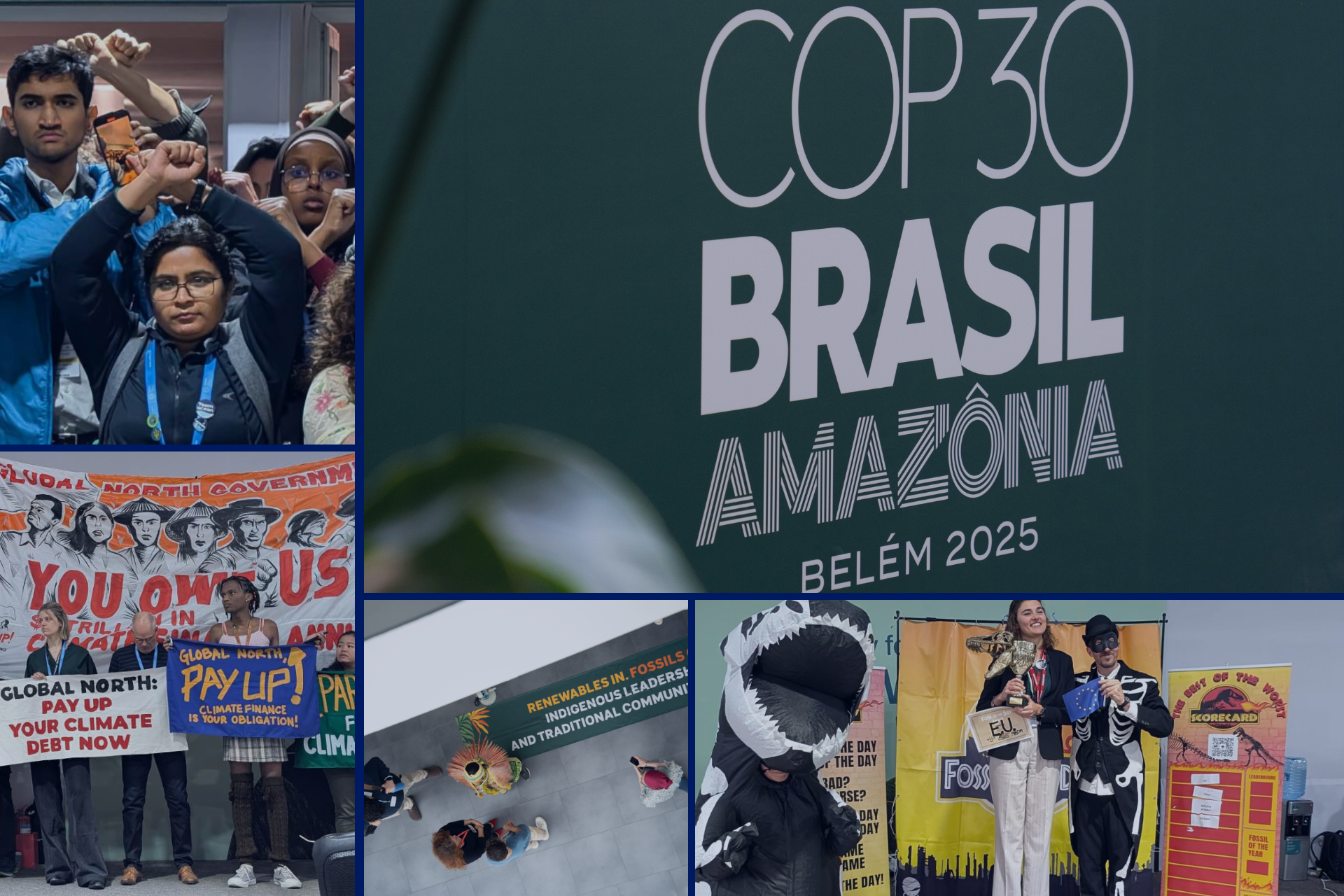
COP30 Recap
COP30 Supported A Just Transition Mechanism – But Left Civil Society’s Justice Package Undelivered
Co-funded by the European Union. Views and opinions expressed are, however, those of the author(s) only and do not necessarily reflect those of the European Union or the European Climate, Infrastructure and Environment Executive Agency (CINEA). Neither the European Union nor the granting authority can be held responsible for them.