The proposed EU–Mercosur Free Trade Agreement (FTA) is presented as a strategic response to rising geopolitical tensions, economic rivalry, and supply-chain disruptions. Yet, a new economic study of the trade agreement, authored by economists Orsola Costantini and Alex Izurieta and commissioned by CAN Europe, shows that once more realistic economic dynamics are considered, the agreement is unlikely to deliver the benefits its supporters promise.
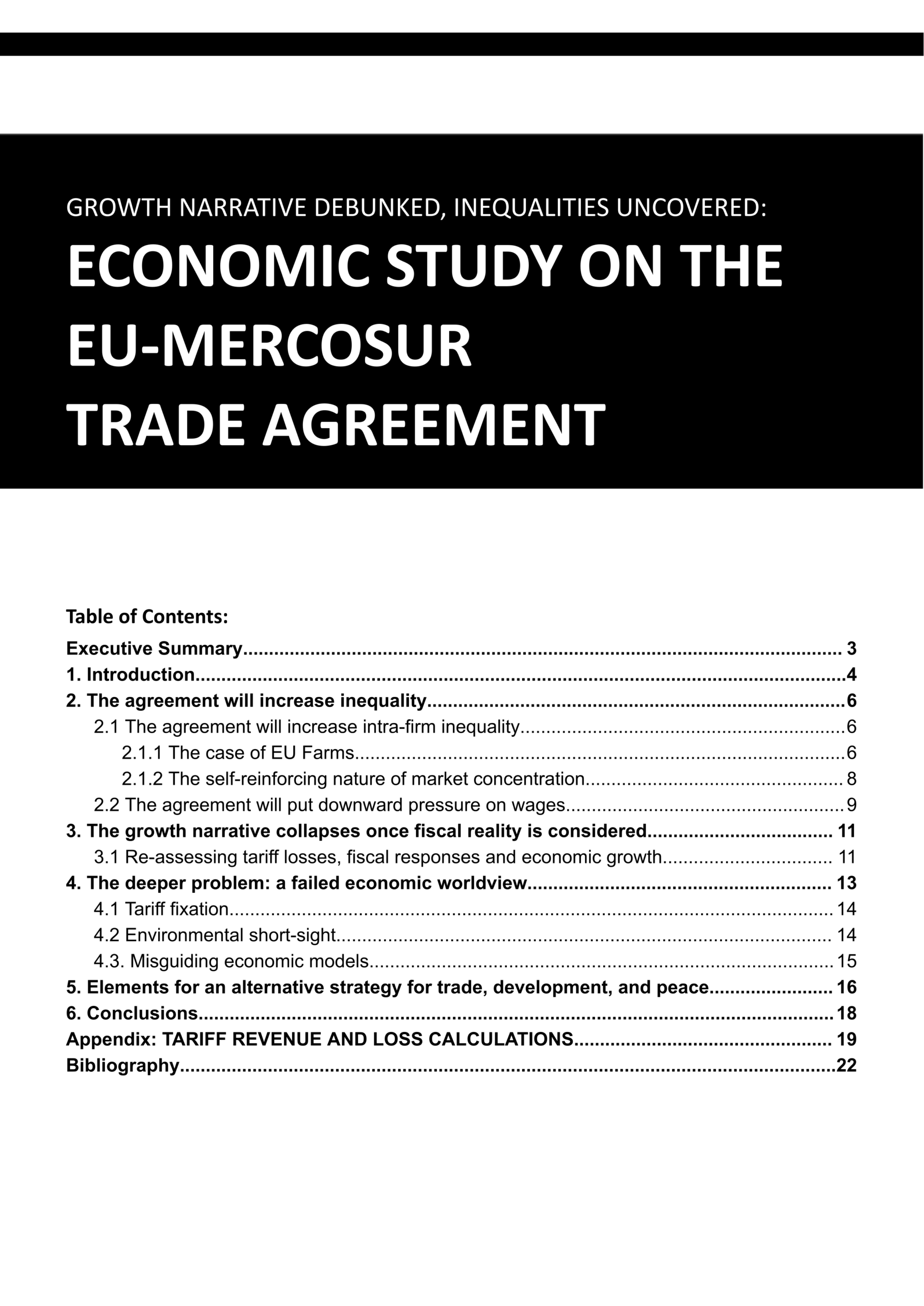
Growth Narrative Debunked, Inequalities Uncovered: Economic Study on the EU-Mercosur Trade Agreeme
Our findings dismantle the promises surrounding the EU–Mercosur agreement: it’s bad for growth; it’s bad for equality; it’s bad for agriculture. Today’s challenges require a different approach than a narrow free-trade framework.
Orsola Costantini, an author of the report and Senior Research Associate at the Institute for Economic Justice
We show that the economic models used to justify free trade agreements are fundamentally flawed and they blindside against the real challenge of international cooperation: identifying common objectives that are economically coherent, mutually achievable, and sustainable over the long term.
Alex Izurieta, an author of the report and a former Senior Economist at UNCTAD
Key findings:
➔ Projected growth gains are negligible and may disappear entirely once fiscal constraints, income distribution effects, and market concentration are taken into account.
➔ Mercosur economies would likely experience slower, not faster, growth. Tariff cuts would significantly reduce public revenues in Mercosur countries, where tariffs remain an important source of government income. Under existing fiscal constraints, this is likely to trigger public spending cuts, leading to slower economic growth rather than expansion.
➔ The EU would see little or no growth benefits. Increased competition between unequal economies with large wage gaps tends to put downward pressure on workers’ share of income. The agreement could lead to a shift of up to €60 billion annually away from wages to companies’ profits in the EU once fully implemented. Moreover, even when accepting the European Commission’s economic assumptions of projected GDP gains, the calculations presented in this paper show that the cumulative effect of falling labour income shares would, in the years following full implementation, eventually eliminate the expected growth boost and lead to a net GDP slowdown of approximately 0.01%.
➔ Inequality would increase. Small and medium-sized farmers, workers in exposed sectors and regional economies would be particularly affected. Even small declines in agricultural producer prices could push thousands of farms into economic vulnerability, driving further land concentration in the agricultural sector and the dominance of large agribusiness. Our analysis shows that a drop of 2% in beef producer prices – consistent with official projections – would increase the number of economically unviable farms across several EU member states.
➔ Public policy space and governments’ ability to pursue alternative economic policies would be reduced, limiting their capacity to manage economic, social and climate transitions.
➔ Consumers would not necessarily benefit from lower prices. In highly concentrated food supply chains, lower producer prices are unlikely to translate into cheaper food because the gains are more likely to be captured by large processors and retailers.
More fundamentally, the EU–Mercosur agreement is built on an outdated neoliberal trade framework centred on tariff cuts and market liberalisation. This mindset also relies on economic models, like the computable general equilibrium (CGE) model used by the European Commission, which systematically downplays power imbalances, inequality, fiscal constraints, and ecological limits. The result is a trade strategy that promises geopolitical stability and economic growth but risks deepening inequality, weakening policy space, and reinforcing unsustainable production patterns.
The paper argues that cooperation between the EU and Mercosur should move beyond narrow neo-liberal free-trade logic and focus instead on a development-oriented economic model, and discusses the bases of an alternative strategy for future trade and cooperation.
This deal builds on a trade recipe that has failed on resilience, sustainability and fairness. It risks deepening structural imbalances, reinforcing unsustainable production patterns while restricting governments’ ability to pursue alternative economic strategies, precisely when rising inequality and the climate crisis demand flexibility and a fundamental rethink of trade.
Audrey Changoe, Trade and Investment Policy Coordinator at Climate Action Network Europe
This study is commissioned by Climate Action Network (CAN) Europe and coordinated by Audrey Changoe, Trade and Investment Policy Coordinator at CAN Europe.
For more information and interview requests:
Jani Savolainen, Senior Communications Coordinator, jani.savolainen@caneurope.org
More on EU-Mercosur
-
Legal Analysis: How Sustainable is the EU-Mercosur Agreement?
The legal analysis of the sustainability of the EU-Mercosur Agreement finds that the agreement has the potential to undermine the EU’s existing commitments to… -
Legal opinion: Bilateral safeguard measures for the agri-sector in the EU-Mercosur trade deal
In the context of the ratifying process of the EU-Mercosur Partnership Agreement (“EMPA”), this legal opinion is to examine whether the bilateral safeguards c… -
Mileinomics: Fossil fuel expansion, climate denialism and the betrayal of human rights in Milei’s Argentina & Why it’s time to drop the EU-Mercosur trade deal
Milei’s so-called “libertarian experiment”, or ‘Mileinomics’, for radical free-market reforms combined with the outdated EU-Mercosur deal are a recipe for eco…