The EU Emissions Trading System (ETS) is a carbon pricing tool that regulates about 36% of the EU’s total greenhouse gas emissions and covers the power sector, the industry sector and the aviation sector. The remaining emissions are covered by the Effort Sharing Regulation (ESR). It is the world’s largest carbon market, covering around 9,500 industrial and power plants in the EU, as well as in Iceland, Liechtenstein, Norway and Northern Ireland.
The EU ETS sets a limit on the amount of greenhouse gas emissions that can be emitted by all sectors covered by the system. Installations receive or buy pollution permits – called EU allowances. One EU allowance allows for one tonne of CO2 equivalent to be emitted. Each year, the limit, or cap, of allowances in the system becomes slightly more stringent. With a decreasing supply of allowances, the price of each permit, the ETS carbon price, should increase, making dirty business unprofitable over time.
Despite being hailed as the flagship of European climate policy, the EU ETS has a notorious history of weak and ineffective carbon price signals, major exemptions for polluting industries and a lack of incentives for sectors, particularly industry, to invest into deep decarbonisation. Even a recent revision of the system failed to align the EU ETS with the objectives of the Paris Agreement. Thus, the EU ETS continues to be in dire need of reform.
In the summer of 2021, as part of the Fit For 55 package, the European Commission presented a proposal to revise the EU carbon market. In order to turn the EU ETS into a true driver towards climate neutrality, the EU carbon market needs to deliver much more emission cuts, cancel all surplus allowances that drag on the carbon price signal, phase out the massive free handouts of pollution permits to heavy industry and ensure that currently unregulated sectors, such as international aviation and shipping, are included in the system and start paying for their emissions.
News & Publications
-
Letters & Statements
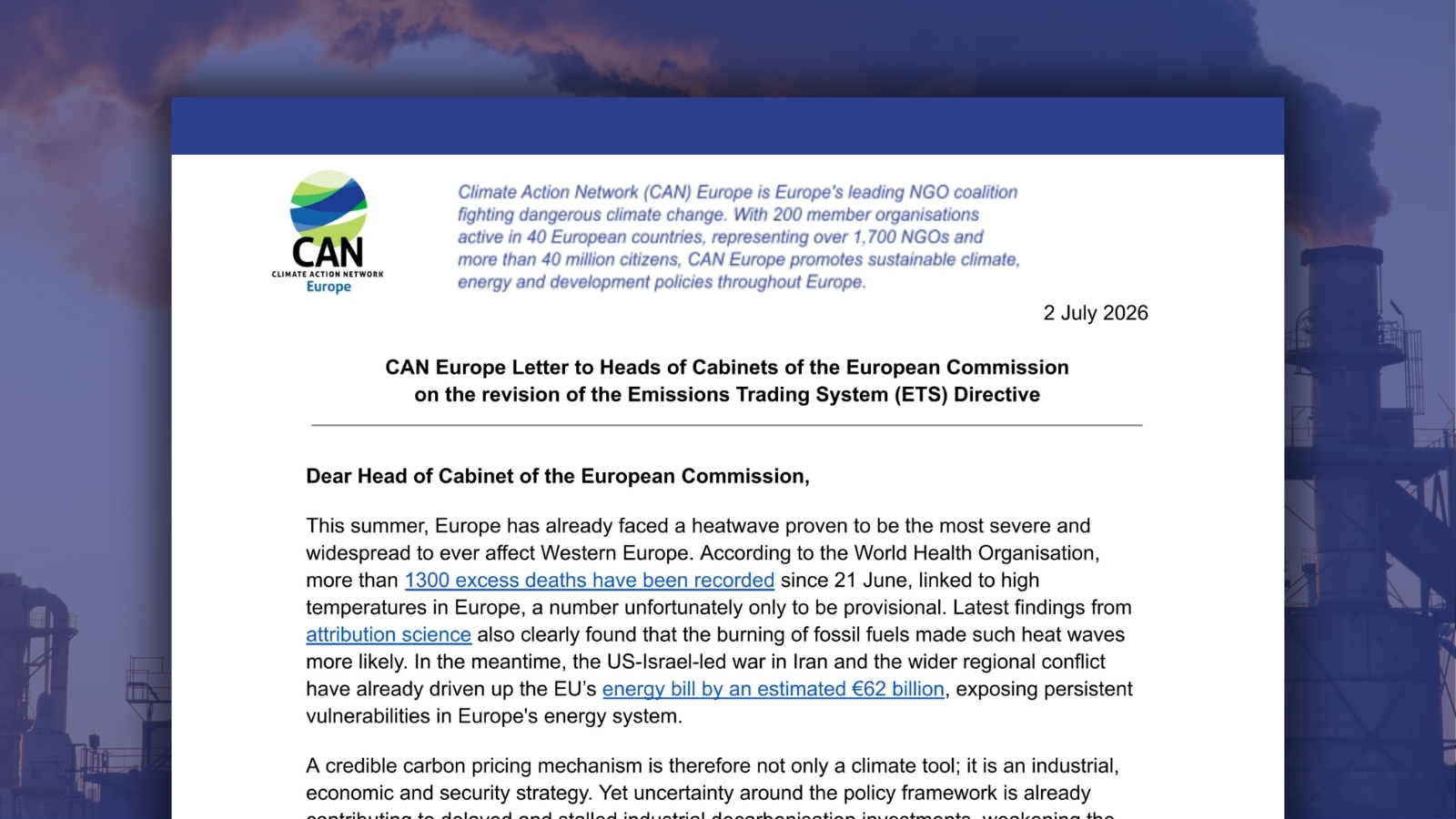
CAN Europe Letter to Heads of Cabinets of the European Commission on the revision of the Emissions Trading System (ETS) Directive
-
Letters & Statements
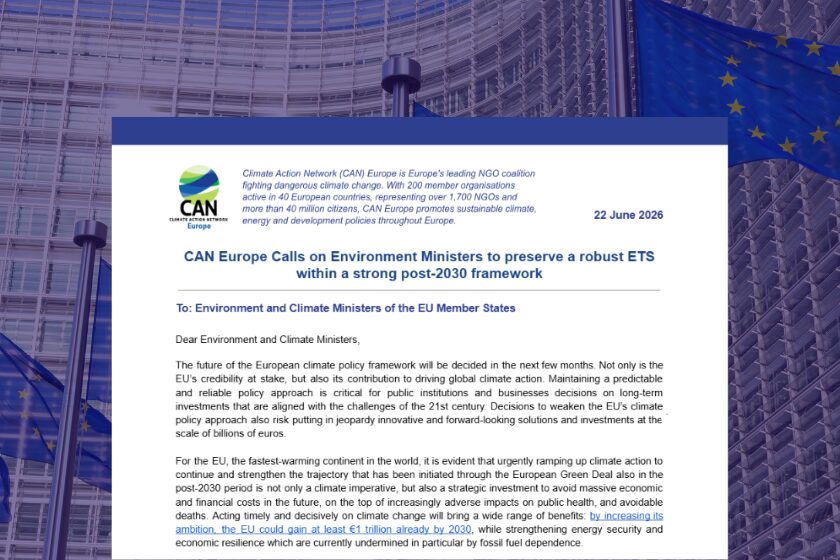
Letter to Environment Ministers to preserve a robust ETS within a strong post-2030 framework
-
Letters & Statements
Open letter on protecting the Social Climate Fund, following the suggestion to postpone ETS2