Europe’s climate dividend: Economic benefits, jobs, health and lower energy costs
‘Europe’s climate dividend: Economic benefits, jobs, health and lower energy costs’ report shows climate action does not mean only cutting emissions but also brings a whole range of benefits, directly impacting people’s daily lives. It puts numbers on benefits of climate action that are often missing from debates focused on the cost of the transition: lower energy expenditure, new jobs, better health, fewer working days lost to illness and avoided global climate damage.
Executive summary
Since the 1980s, Europe has warmed at roughly twice the global average, and the economic toll is mounting to match. According to the European Environment Agency, weather and climate extremes have cost the EU an estimated €822 billion in losses between 1980 and 2024, with a quarter of that total between 2021 and 2024, each ranking among the five costliest on record. The same events have caused more than 441,000 deaths over the same period.
Our landmark 2024 Paris Pact Payoff report concluded that for the EU as a whole, the benefits of ramping up climate action (by implementing a 1.5°C-aligned pathway) significantly outweigh the costs, and direct co-benefits amount to at least €1 trillion by 2030. What has changed since the first report was published is not just the underlying economics, but also the politics around them.
The EU adopted a binding 90% emissions reduction target for 2040 which became law in March 2026, but only after sustained industry pushback and open opposition from several member states, and the debate has shifted from whether to act to whether Europe can afford to. Renewed fossil fuel price volatility tied to the US-Israel war on Iran has also highlighted again what was already stated and shown by the Russian aggression on Ukraine: continued dependence on imported fossil fuels is itself a cost and a vulnerability, not a safe default.
This report updates our evidence base against that backdrop, showing that the direct co-benefits of climate action, on jobs, health, and household energy costs, remain large and growing, restating the positive impact decarbonization has on many layers of society.
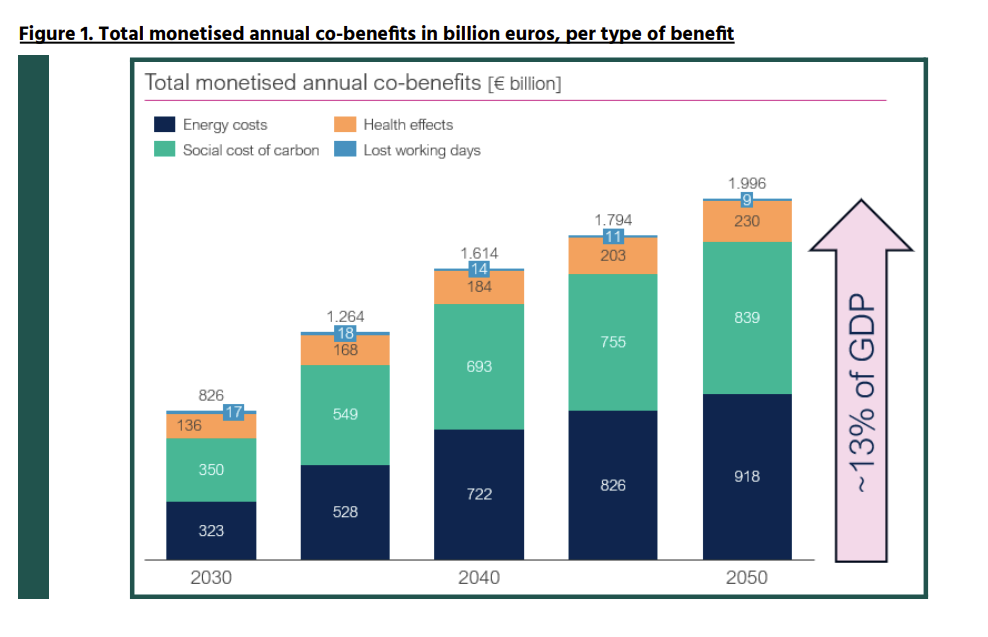
Energy saving measures could provide over €826 billion in yearly monetised co-benefits by 2030 and nearly 2 trillion by 2050 (13% of EU27 2021 GDP)
Energy saving measures across the EU27 generate benefits beyond lower energy bills, including avoided global climate damage, improved public health, and fewer working days lost to illness. As shown in Figure 1, these combined co-benefits are projected to more than double, from €826 billion a year in 2030 to nearly €2 trillion a year by 2050, equivalent to about 13% of EU27 2021 GDP.
Cumulated, the considered energy savings and renewables deployment account for almost €32 trillion in monetized co-benefits over the period 2030-2050.
Import dependency
While this report quantifies energy cost savings as a direct co-benefit of carbonisation measures, it’s worth stating the scale of the exposure those savings help address.
Eurostat data show the EU’s energy import dependency rate stood at 58% in 2023, meaning nearly 60% of the bloc’s energy needs were met through net imports, with individual member states ranging from under 5% to over 90%. Oil and petroleum products alone accounted for 67% of the EU’s energy imports in 2024, and overall fossil fuels for 95%.
Reducing this dependency matters beyond cost: heavy reliance on fossil fuels leaves European consumers exposed to geopolitical pressure, price shocks, and supply disruptions largely outside the EU’s control, risks that recent Gulf tensions and the post-2022 scramble to replace Russian gas have both made concrete rather than hypothetical.
Energy saving investments could support over 8.5 million jobs in 2030, mainly from the renovation wave
Investments in energy saving measures translate directly into employment, from construction and renovation to the installation of new heating and mobility technologies.
These investments could support ver 8.5 million new full-time-equivalent jobs in 2030, of which 6.5 million come from construction and renovation alone, and continue to provide between 3.5 and 5.8 million jobs a year through 2050.
Reducing air pollution and insulating homes could prevent almost 34 000 deaths annually by 2030.
Better-insulated homes and lower exposure to air pollution translate directly into public health gains: additional climate action could prevent almost 34,000 deaths a year by 2030 (from these channels alone; other climate-related mortality, notably from heatwaves, is not included), alongside 8,000 fewer hospital admissions.
Reduced excess cold-weather mortality is the largest of these benefits, with over 21,000 premature deaths avoided annually by 2030, rising to up to 50,000 by 2050.
To note: this sum does not include deaths as a consequence of extreme weather events and climate change itself, but avoided deaths as a consequence of the energy transition – which comes on top of the tragic loss of human lives due to extreme weather events.
Europe’s climate dividend: Economic benefits, jobs, health and lower energy costs