The EU ETS debate is one of the most important – and consequential – debates shaping Europe’s climate and energy policy. With major decisions ahead, understanding how the system works and why it matters has never been more important.
That’s why we’ve put together a one-stop shop for everything you need to know about the EU ETS: from the basics to the big questions shaping its future. Whether you’re new to the EU ETS or looking for a quick refresher, this is your starting point for navigating the debate.
-
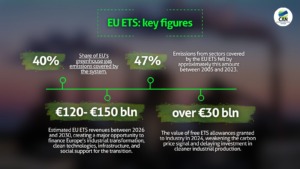
The EU Emissions Trading System (EU ETS), launched in 2005, is the world’s first major international carbon market and is based on the principle of “making polluters pay.” It requires companies to pay for their greenhouse gas emissions while generating revenues to support the clean energy transition. The system covers emissions from electricity and heat generation, energy-intensive industries, aviation, and, since 2024, maritime transport, accounting for around 40% of the EU’s total emissions. It applies across the EU, as well as in Iceland, Liechtenstein, and Norway.
The EU ETS operates on a “cap and trade” model. A cap is set on the total amount of emissions allowed and is reduced each year in line with the EU’s climate targets. Companies must surrender allowances for every tonne of CO2 emitted, creating a financial incentive to cut pollution. Allowances can be bought, sold, and traded on the carbon market. By allowing companies to reduce emissions where it is most cost-effective, the ETS helps achieve climate targets at lower overall economic cost. Since 2005, the EU ETS has helped reduce emissions from Europe’s power and industrial sectors by around 47%.
ETS is a cornerstone of the EU’s climate policy, but it is not only a climate tool; it is a critical piece of the EU’s long-term industrial, economic and security strategy. If used properly, the revenues it generates can support investments in competitive clean industries, innovation, modern energy infrastructure, and accessible net-zero technologies, while also helping households and workers navigate the social and economic impacts of the transition.
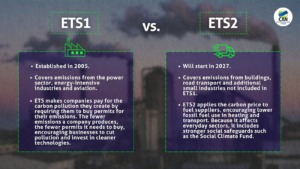
 The EU Emissions Trading System is divided into two separate schemes: ETS1 and ETS2. ETS1 covers emissions from the power sector, energy-intensive industries, and aviation within Europe. It targets large emitters and works by requiring companies to buy allowances for their greenhouse gas emissions, thereby encouraging investment in cleaner technologies. ETS2 is a newer system that will apply to emissions from buildings, road transport, and additional small industries. Rather than targeting households directly, ETS2 places the carbon price on fuel suppliers, creating incentives to reduce fossil fuel use in heating and transport. While ETS1 focuses mainly on industry and electricity generation, ETS2 extends carbon pricing to sectors that are closely linked to citizens’ daily lives, making social fairness and support measures, such as the Social Climate Fund, particularly important.
Read CAN Europe’s position paper on ETS1 and on ETS2.
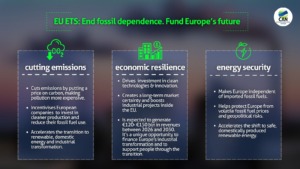
 EU ETS must remain the cornerstone of EU climate and industrial policy. This is not only a climate imperative, but a matter of economic resilience and energy security. Europe still spends nearly €400 billion each year on fossil fuel imports, exposing its economy to geopolitical risks, price volatility and supply disruptions. Recent events have once again shown how quickly these vulnerabilities translate into real economic costs. Reducing this dependence requires accelerating the transition to renewable, domestic energy and industrial transformation. The EU ETS plays a central role in this process by creating incentives to cut emissions, while making available large sums of money to innovate and invest in clean technologies, and to reduce reliance on imported fossil fuels.
Yet despite its importance, in the first half of 2026, the EU ETS has been cast as a scapegoat in an increasingly heated debate over Europe’s industrial future. The coordinated attack from fossil fuel incumbents and vested interests is unprecedented in scale.
At the same time, there is a broad and growing support to maintain the EU ETS – not only from civil society, but also from a wide range of businesses and industrial actors calling to stay the course on climate action.
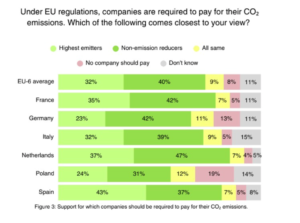
 There is widespread public support for ETS’s core principles: making polluters pay, rewarding industrial decarbonisation. Seven out of ten European citizens (72%), including those voting for parties often portrayed as sceptical of EU climate policy, believe that companies that emit the most – or fail to reduce their emissions – should pay more. A new poll, commissioned by Beyond Fossil Fuels on behalf of a broad community of organisations, and conducted by YouGov across six European countries, finds broad support for the “polluter pays” principle at the heart of the EU Emission Trading Scheme (ETS), cutting across national and political divides.
A majority of 59% of respondents across France (66%), Germany (47%), Italy (65%), the Netherlands (71%), Poland (40%) and Spain (68%) think that heavy industries, such as steel, cement, and chemicals, should pay for their CO₂ emissions. Support rises to more than two-thirds in Spain, France, Italy and the Netherlands, while opposition across the six countries stands at just 23%. Beyond pricing polluters, respondents also expect the system to reward climate ambition, with 7 out of 10 participants believing that companies emitting the most – or failing to reduce their emissions – should pay more than others.
Support goes well beyond the “green electorate”, including even voters of governing parties that have called for changes to or a weakening of the EU ETS. This becomes strikingly clear in Italy, where 71% of voters of Fratelli d’Italia, the party led by Prime Minister Giorgia Meloni, express support for making heavy industries pay for their emissions. In France, 73% of Emmanuel Macron’s voters and 55% of Marine Le Pen’s voters back the same principle. In Poland, 57% of voters of Koalicja Obywatelska (KO), led by Prime Minister Donald Tusk, are in support.
At present, there is still very limited transparency on how revenues are used and only a small share is directed explicitly towards financing the transition. The current list of eligible spending priorities is outdated and needs a fundamental overhaul. Member States should also be required to publish clear, detailed and comparable information on how ETS revenues are spent.
Every euro from the EU ETS should help speed up the energy transition and deliver tangible benefits for people. Between 2026 and 2030, the EU ETS is expected to generate €120–150 billion in auction revenues for Member States, while the Innovation and Modernisation Funds could mobilise an additional €93 billion for climate action. These resources represent a unique opportunity to modernise Europe’s economy, strengthen energy security, and support citizens through the transition.Revenues should be invested transparently and strategically in industrial transformation, clean infrastructure, innovation, and social support. A strong focus must be placed on helping lower-income households and vulnerable groups through measures such as building renovation, energy efficiency, affordable renewable heating and cooling, clean mobility, and better public transport. This is essential to ensure that the transition reduces both emissions and inequality, rather than deepening existing vulnerabilities.
Some Member States are already showing how ETS revenues can be used effectively. In Belgium and France, auction revenues have supported targeted renovations of social housing, cutting emissions while improving living conditions and reducing energy bills for low-income households.
ETS revenues must not be used to prolong fossil fuel dependence. In particular, support for fossil fuel-based electrification and compensation for fossil-based electricity use should be phased out. The current system of Indirect Cost Compensation (ICC) is fundamentally flawed. By compensating electricity consumption regardless of whether it is based on fossil fuels, the mechanism weakens incentives for electrification based on renewable energy, lacks transparency and is implemented inconsistently across Member States. ICC should therefore be fundamentally reformed and progressively phased out.The EU ETS is expected to generate between €120 and €150 billion in revenues between 2026 and 2030, offering a unique opportunity to finance Europe’s industrial transformation, invest in clean technologies and infrastructure, and support households and workers through the transition. At a time of intensifying global competition for the clean industry, weakening the ETS would undermine investment certainty and risk pushing clean industrial projects outside the EU.Since 2005, emissions in the sectors covered by the EU ETS have fallen by around 50%. The strongest progress has been achieved in the power sector, where the combination of carbon pricing, renewable deployment and fuel switching has driven rapid reductions. Business representatives have recently called it a “competitiveness engine for Europe”, which has “driven billions of euros of investments by early movers, has provided a market signal for innovation and can be the demand signal for European cleantech solutions to scale.”
Weakening the EU carbon price would push investment in clean industrial production to regions that are moving faster and providing greater certainty, while penalising first movers who already launched investments in Europe. Without a strong and predictable ETS, the business case for clean steel, green chemicals, circular materials and electrified production weakens significantly, undermining the objectives of both the Clean Industrial Deal and future instruments such as the Industrial Accelerator Act.
Europe’s high fossil fuel imports make it exposed in two ways: first, by deepening dependence on countries increasingly willing to weaponise energy dependency for geopolitical ends; and second, by locking Europe into a global fossil fuel system that is structurally vulnerable to shocks, price spikes and conflict. Since the US and Israeli attacks on Iran in 2026 began, the EU’s fossil fuel import bill has jumped €22 billion in just 44 days, complained EC President Ursula von der Leyen in mid-April 2026. The recent destruction of oil and gas infrastructure in the Middle East is only the latest reminder that Europe’s prosperity remains tied to unstable supply chains and geopolitical chokepoints as a consequence of a lack of determination in moving away from fossil fuels.The ETS already is an independence instrument, as it has allowed the EU to save 100 billion cubic metres of fossil gas consumption.
CAN Europe strongly criticises the Commission’s choice to propose heavy weakening of the EU Emissions Trading System (ETS) revision, undermining the EU’s climate, industrial transformation and energy security objectives.Lowering the Linear Reduction Factor to 3.7% from 2031 onwards and 1.7% afterwards, from currently 4.4%, would simply allow more pollution from power plants and heavy industry, while a large part of decarbonised solutions are already available. Those emissions would not disappear. Instead, they would impose additional costs on European citizens and companies, and force deeper and politically more difficult cuts from sectors such as buildings, agriculture and transport if Europe is to meet its legally binding 2040 climate target. CAN Europe is also concerned that a substantial amount of international credits would be allowed in the framework.
The ETS review must end European industry’s dependence on free pollution permits, which have consistently undermined decarbonisation investments in energy-intensive sectors such as steel. Extending free allocations until 2038 for sectors covered by the Carbon Border Adjustment Mechanism (CBAM) runs counter to the objective of phasing them out, particularly given that some sectors have faced very little – if any – effective carbon price signal in recent years.
Allowing carbon removals in the mix would dilute the environmental integrity of the ETS. Carbon removals may have a role in addressing genuinely unavoidable emissions, but they must never become an excuse for delaying emissions reductions at source.
The upcoming ETS review is a critical moment to strengthen and not dilute the system, ensuring it delivers rapid decarbonisation while supporting prosperity and resilience. Calls to dilute the ETS would therefore freeze investment decisions, penalise first movers and lock Europe into yesterday’s industrial model at precisely the moment when the global race for clean industry is accelerating.CAN Europe’s priorities for the next review:
- The current cap trajectory and linear reduction factor should be preserved at least until 2036, providing the predictability needed for immediate long-term investments. Discussions about additional flexibility should concern only the period thereafter, when limited liquidity risks might need to be addressed.
- The phase-out of free allocations must continue. In 2024 alone, free allocation still represented more than €30 billion in forgone auction revenues, while also weakening the carbon price signal for industry. Maintaining generous free allowances would only delay investment in cleaner production and undermine the effectiveness of the ETS. Conditionalities attached to any remaining free allocations should be strengthened in order to force additional investments in industrial transformation and deep emission cuts.
- ETS revenues must be used strategically. Auction revenues should support in the first place a just transition for citizens, while also speeding up the transformation of European industry. This means investing in clean industrial technologies, infrastructure and deployment of renewables, while also helping households and workers cope with the costs of the transition, both within Europe and internationally. Within Europe, there is also a need to continue allocating revenues specifically to those regions where transition costs are higher.
- The integrity of the ETS must be protected. International credits and carbon removals should remain outside the system. Introducing them into the ETS would weaken the carbon price, reduce incentives for real emission cuts in European industry and risk undermining confidence in the system.
Read our position paper for more details on these priorities.
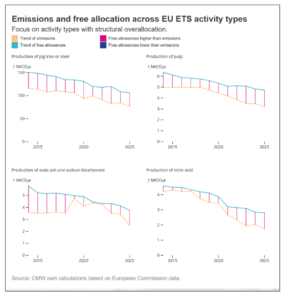
Free allocation of EU allowances has long been presented as a temporary instrument to shield industry from carbon costs and mitigate carbon leakage risks. Empirical evidence suggests that economy-wide leakage has not materialised at a large or systematic scale, even if some sector-specific and trade-related effects have been identified in energy-intensive industries. In practice, it has nevertheless become a structural feature of the EU ETS, dampening the carbon price signal and reducing abatement incentives, thereby weakening the system’s overall efficiency and environmental integrity.Between 2008 and 2021, heavy industry received approximately €200 billion worth of EUAs at no cost. In 2024 alone, nearly 500 million allowances – valued at over €32 billion were still handed out for free. These are forgone revenues that could otherwise fund climate action, social support, and the transformation of the European economy. Sectors like metals, minerals, chemicals, and paper firms often received more allowances than their verified emissions, generating windfall profits concentrated in iron and steel, cement, petrochemicals, and refineries, estimated between €26 billion to €46 billion. Despite these handouts, the industry has favoured short-term financial gains over long-term investment in the green transition. Many companies have prioritised share buybacks and dividend payouts while dropping capital expenditure, which on average has fallen from 18.4% in 2010 to 14.9% in 2023.
Free allocations were always intended as temporary. To restore integrity to the EU ETS, free allocations must be fully phased out. For CBAM-covered products, the planned phase-out trajectory must be respected. For non-CBAM ETS sectors deemed at risk of carbon leakage, including refineries and chemical producers, free allocation must end no later than 2034 by including sectors such as plastics into CBAM. Any remaining free allocations must be made strictly conditional on additional, verifiable decarbonisation investments.
 No. While the EU ETS is the world’s largest and most well-known carbon market, carbon pricing is used in many parts of the world. Today, 80 carbon pricing schemes are existing across 95 jurisdictions, covering more than a quarter (28%) of global greenhouse gas emissions.
Countries such as Canada, the United Kingdom, Switzerland, New Zealand, South Korea, and China have implemented carbon pricing systems. China, in particular, operates the world’s largest emissions trading system by emissions covered. Several US states, including California and those participating in the Regional Greenhouse Gas Initiative (RGGI), also use carbon markets. In Latin America, countries such as Chile and Mexico have introduced carbon taxes, while South Africa and Singapore also apply carbon pricing mechanisms.
Check the World Bank Carbon Pricing Dashboard, which tracks carbon pricing systems around the world.