Methane mitigation for EU energy security: an analysis of supplier risks and abatement potential
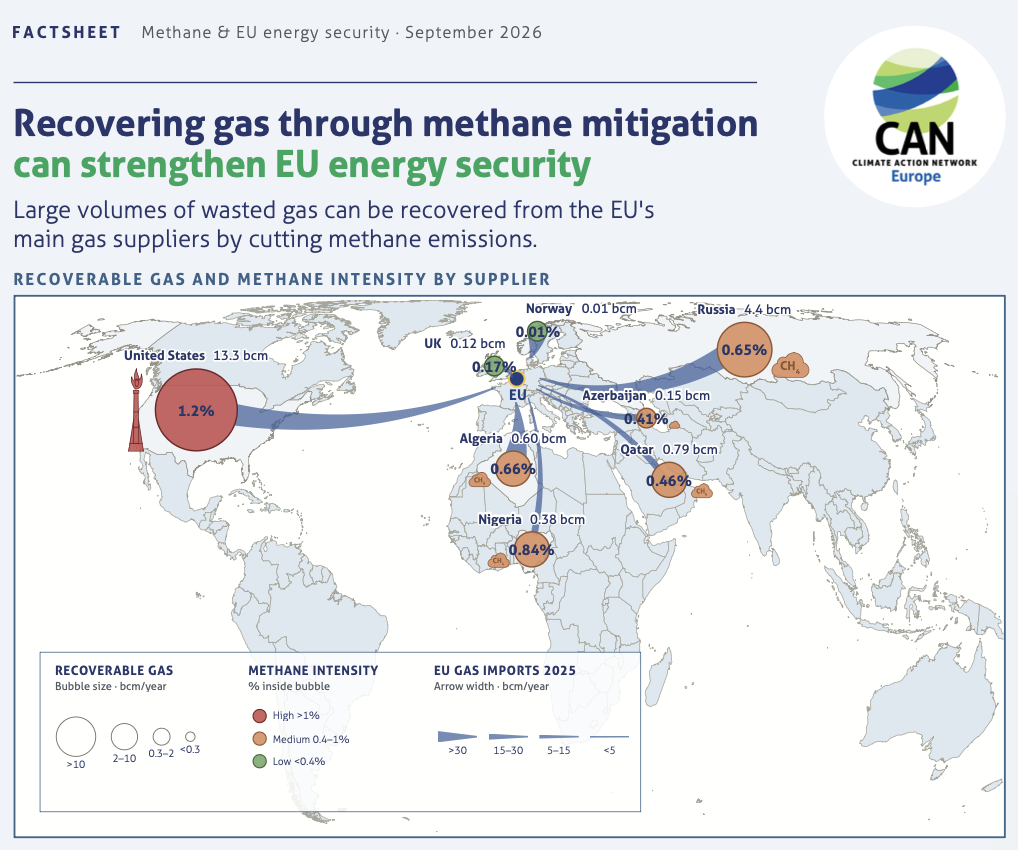
Brussels, 18 September 2026 – As Europe heads into winter amid tight gas supplies and soaring energy prices, a new policy brief by Climate Action Network (CAN) Europe highlights that implementing methane abatement measures across the EU’s main gas suppliers could recover around 20 billion cubic metres (bcm) of gas – roughly twice the amount of gas the EU imported from Qatar in 2025. Extending methane abatement to oil operations could recover up to 43 bcm, more than half of the EU’s US LNG imports in 2025.
In parallel, CAN Europe together with 21 NGOs sent a letter to national ministries and competent authorities responsible for implementing the EU Methane Regulation (EUMR), stressing how the recent Commission’s Recommendations can help with pragmatic implementation at the national level.
As industry and some governments push to reopen the EUMR on unfounded energy security grounds, the evidence points elsewhere: Europe’s vulnerability to energy shocks is driven by its continued dependence on imported fossil fuels, not by methane rules.
Since the US war on Iran started, the EU has added over €53 billion to its fossil fuel import bill. Supply disruptions have pushed European gas prices sharply higher, while Europe is entering winter with its lowest gas stocks on record, with further price increases expected. Yet huge amounts of gas are being lost through avoidable methane leakages before they even reach Europe.
“Europe is paying premium prices for gas while billions of cubic meters are being released into the atmosphere, and consumers are still paying for that wasted gas. Cutting avoidable methane emissions from the EU’s biggest fossil fuel suppliers could recover twice the amount of gas we imported from Qatar last year, without producing a single new molecule of gas. If the EU is serious about energy security and affordability, it must stop methane losses and fully enforce the EU Methane Regulation as a key measure leading towards a full gas phase out.” says Ioanna Souka, Gas Data Analyst at Climate Action Network (CAN) Europe.
- Key messages from CAN Europe’s policy brief
Existing methane abatement measures across the EU’s main fossil gas suppliers – including Norway, the United States, Russia, Algeria, the United Kingdom, Azerbaijan, Qatar and Nigeria, which together account for more than 95% of the EU’s imported fossil gas – could recover around 20 bcm of gas from gas operations alone, rising to 43 bcm when oil operations are included. - Across these suppliers, around 29% of potential methane reductions from fossil gas operations could be achieved at negative net cost, because the value of recovered gas can exceed the cost of stopping the emissions. When zero- and near-zero-cost measures are included, the share of economically attractive reductions rises to 49%.
- The US represents the single largest methane reduction opportunity worldwide. As the top global source of methane emissions from the gas sector, it also holds about 73% of the potential cuts from gas operations alone. Norway and the UK, by contrast, have more limited additional potential, given their already stronger methane management practices.
- Growing reliance on US LNG creates a new risk for the EU. The US supplied around 58% of EU LNG imports in 2025, making it the bloc’s dominant LNG supplier at a methane intensity of 1.2%, six times the OGCI’s 0.2% benchmark. Increased dependence on US LNG risks trading Europe’s dependency on Russian fossil fuels for a new, highly emissions-intensive one.
CAN Europe calls for action
Now is the time for the EU to stand firm on its methane rules and accelerate implementation. Embedding them into a broader fossil gas exit strategy – including a phase out of US LNG imports by 2032 – would strengthen energy security while supporting the EU’s long-term climate goals.
Accelerating energy efficiency, renewables, electrification, alongside a 7-8% annual reduction in gas demand, could bring EU gas demand down to 190 bcm by 2030, in line with the REPowerEU trajectory, and put the EU on track to phase out gas by 2035.
ENDS
Background information
Methane, a superpollutant more than 80 times more powerful than CO2 at warming the planet over the short term, is released at every stage of the fossil fuel supply chain, wasting around 200 bcm of gas globally each year while accelerating the climate crisis. For the EU, which imports around 90% of its oil and gas consumption, stopping these avoidable emissions is not only a climate priority but also an energy security opportunity.
The EU Methane Regulation, adopted in 2024, requires oil, gas and coal operators to measure, report and verify methane emissions, detect and repair leaks, and eliminate routine venting and flaring. It also introduces methane reporting requirements for imported fossil fuels, with importer obligations starting from 2027 and methane intensity requirements applying from 2030.
Methane rules do not constrain supply: methane rules were deliberately designed with a flexible compliance pathway, giving companies time to build monitoring and reporting systems before the strongest requirements take effect. The volume of gas able to meet the Regulation’s highest reporting standards is expected to exceed current EU import volumes by more than three times, giving the EU ample choice of suppliers even as methane standards are strengthened. Numerous long-term gas contracts have also been signed since 2024, showing methane rules haven’t stopped suppliers committing to the EU market, contrary to claims from the fossil fuel industry and the US administration in their push to delay the rules.
Implementation must protect the Regulation’s integrity: On 20 July 2026, the European Commission issued implementation recommendations, including a call for Member States to suspend penalties for non-compliant importing suppliers by three years. Ahead of the 22 September EUMR Expert Group Meeting, a joint NGO assessment of the Recommendations calls on Member States to use these Recommendations to avoid a fragmented implementation of the EUMR. This means not reopening or amending the Regulation, urgently putting effective, proportionate and dissuasive national penalty regimes in place, and endorsing the existing protocols for accrediting national verification of companies’ compliance so that the remaining implementation obstacles can be resolved.
Meanwhile, the European Commission’s Methane Transparency Database, originally planned for February 2026, has been delayed to September 2026. Its timely publication will be essential for governments, companies and the public to assess methane performance across fossil fuel supply chains.
Through the Civil Society Observatory on Methane (CSOM), CAN Europe will continue monitoring implementation of the EU Methane Regulation and calling for stronger enforcement.
For more information and media requests:
Alessia Luzzati, Communications Officer at CAN Europe, alessia.luzzati@caneurope.org
Ioanna Souka, Gas Data Analyst at CAN Europe, author of the policy brief, ioanna.souka@caneurope.org