The “Fit for 55” package which entered into force in 2023 is a key milestone on the way of reaching the overarching climate neutrality goal enshrined in the European Climate Law, also aiming to reduce net domestic emissions by 2030 by 55%. The Regulation (EU) 2018/1999 on the Governance of the Energy Union and Climate Action (Governance Regulation) establishes several mechanisms to ensure that Member States adopt climate policies and measures. The main elements are the National Energy and Climate Plans (NECPs – covering 10 years period) and the national Long-Term Strategies (nLTS – covering a 30 years period). In addition to these planning tools, the Governance Regulation establishes several review and reporting mechanisms.
Climate planning, in particular in the form of NECPs and nLTS, has a crucial importance for the delivering of climate and energy targets. Although there are several planning requirements flowing from EU law, NECPs are the central instruments for climate planning obligations. It is thanks to this exercise that Member States actually assess what policies and measures (including finance) will need to be adopted to achieve their climate and energy targets, the impacts of these policies and measures including on levels of national energy poverty and they are encouraged to also share data on their wider socio-economic implications. The NECP process also requires Member States to engage their citizens in consultation about the proposed measures and policies.
Our analysis of the latest revised NECPs cast serious doubts on their ability to deliver on the Member States’ respective climate and energy objectives, due to the lack of policies and measures (and related financing) to back them up. In 2024, the European Commission president Ursula von der Leyen tasked new Energy Commissioner Dan Jørgensen to revise the Governance Regulation during the upcoming legislature.
CAN Europe has long been involved in monitoring the implementation of the climate and energy governance framework. Since 2019, CAN Europe has been coordinating three LIFE projects aiming to facilitate the effective and early transition of Member States across Europe to low carbon and resilient economies: Unify (2019-2022), Together for 1.5 (2022-2025) and Plan4Climate (2025-2028).
The European Climate Law, the cornerstone of the European Green Deal, was adopted in 2021. This framework legislation writes into law the goal set out in the European Green Deal for Europe’s economy to become climate-neutral by 2050. The law also sets the intermediate target of reducing net greenhouse gas emissions by at least 55% by 2030, compared to 1990 levels.
CAN Europe has worked to influence this new framework throughout the legislative procedure by urging parties around the table to include several key elements, including an at least 65% emission reduction target compatible with science and with the EU’s Paris Agreement commitment. As often, the law could have been far more ambitious, but represents a step in the right direction.
The final version of the law contains the following elements that are worth highlighting:
- 2030 target of ‘at least 55% net’. The 2030 target negotiations were preempted by the European Council conclusions in December 2019, with Heads of States settling for an “at least 55% net” target. In order to implement this target, the Commission adopted or amended from 2021 until 2023 several key EU laws as part of its Fit for 55 legislative package.
- 2050 climate-neutrality objective: The Council was against a climate neutrality that would apply to each Member State individually, it therefore applies to the EU as a whole. Some silver lining was language saying that the EU shall aim to achieve negative emissions after 2050.
- Greenhouse Gas Budget agreed, but only for 2030-2050: The European Commission is required to present a greenhouse gas budget for the European Union, alongside the introduction of a climate target for 2040. When preparing this budget, the Commission is required to consider, among other elements, the advice of the recently created European Scientific Advisory Board on Climate Change (ESABCC), as well as social, economic and environmental impacts, including the costs of inaction.
- European Scientific Advisory Board on Climate Change (ESABCC): The ESABCC is an independent advisory board composed of 15 senior scientific experts covering a broad range of relevant disciplines. It was created by the European Climate Law and started to work in 2022. Its role is to evaluate policies and identify actions and opportunities to achieve the EU’s climate targets. Among others, the ESABCC has provided scientific information to the European Commission in the preparation of the 2040 climate target and 2030-2050 greenhouse gas budget.
- Climate mainstreaming: The European Climate Law requires the Commission to undertake a policy consistency check of EU measures with the 2050 climate neutrality objective. The Commission is also required to assess the progress made by Member States towards the achievement of the climate neutrality objective, both collectively and on the basis of national measures. These assessments are conducted every 5 years, starting in 2023.
Fossil fuel subsidies: Language, in a recital, saying that the EC will have to come up with a better methodology for monitoring at Member State level, but nothing on a possible phase-out date.
News & Publications
-
Letters & Statements
Letter: CAN Europe’s perspective on the upcoming “European climate resilience and risk management – integrated framework”
-
Reports & Briefs
Europe’s climate dividend: Economic benefits, jobs, health and lower energy costs
-
Letters & Statements
Statement from the Coalition for Higher Ambition (HAC) urging to support a robust and ambitious EU post-2030 climate and energy framework
-
CAN Europe Positions
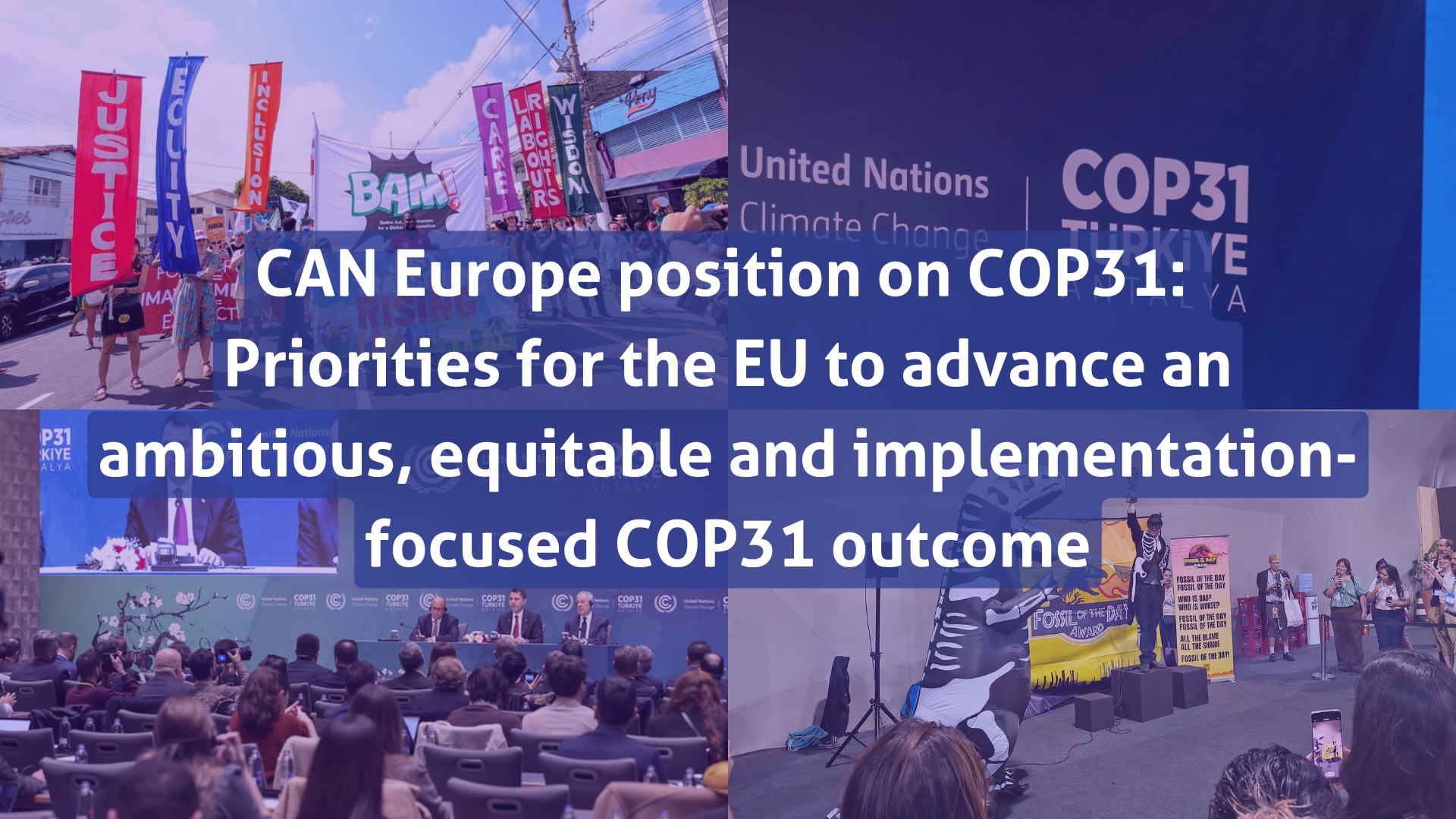
CAN Europe position on COP31: Priorities for the EU to advance an ambitious, equitable and implementation-focused COP31 outcome
-
Letters & Statements
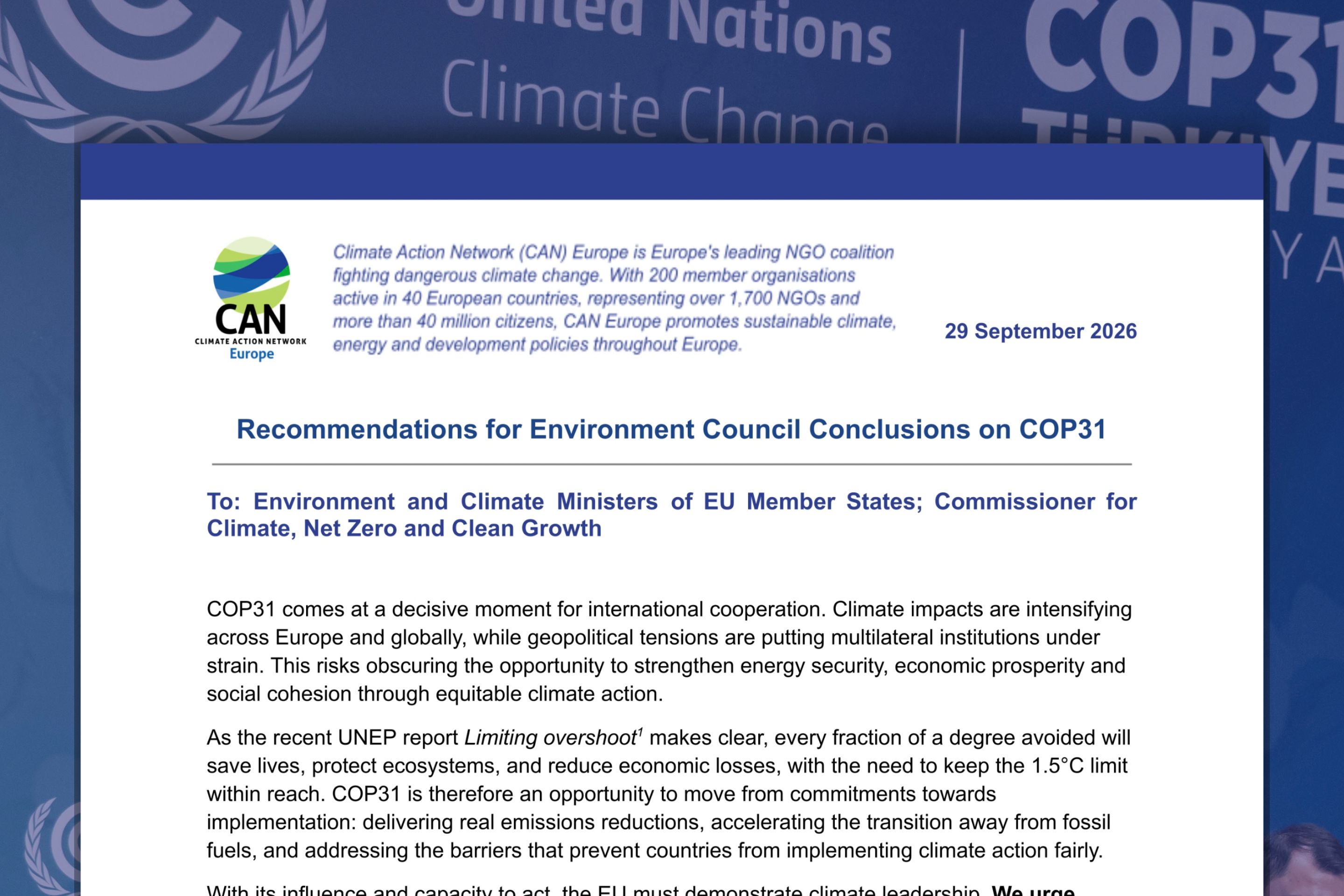
Letter: Recommendations for Environment Council Conclusions on COP31
-
Letters & Statements
Joint Letter to EU Development Ministers: Global Europe is not a residual budget line